Links
Life events
Wikipedia ↗
Wikipedia ↗
Wikipedia ↗
Wikipedia ↗
Wikipedia ↗
Wikipedia ↗
Wikipedia ↗
Wikipedia ↗
Article
Life Summary
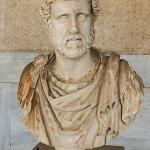
Titus Aelius Hadrianus Antoninus Pius was born on September 19, 86 CE, in Lanuvium, near Rome. He came from a wealthy and politically prominent family, with his father serving as a consul. Antoninus was raised in Lorium, a town near Rome, and received an excellent education in rhetoric and philosophy. He married Annia Galeria Faustina the Elder, with whom he had four children, though only one daughter, Faustina the Younger, survived to adulthood.
Antoninus served as quaestor, praetor, and consul before being appointed as one of the four imperial legates of Italy. His career advanced under Emperor Hadrian, who appointed him as proconsul of Asia around 134 CE. In 138 CE, Hadrian adopted Antoninus as his heir, with the condition that Antoninus would in turn adopt Marcus Aurelius and Lucius Verus as his successors. Upon Hadrian’s death later that year, Antoninus became emperor and ruled until his death on March 7, 161 CE, in Lorium.
Historical Context
Antoninus Pius ruled during a period known as the Pax Romana, a time of relative peace and stability across the Roman Empire. His reign followed that of Hadrian, who had focused on consolidating the empire’s borders and infrastructure. Antoninus continued this legacy but shifted the empire’s focus toward internal stability, legal reforms, and cultural development. His rule is often seen as a golden age, marked by minimal military conflict and economic prosperity.
The empire under Antoninus was vast, stretching from Britain to Mesopotamia, and required careful administration. His policies emphasized fairness, efficiency, and the welfare of provincial subjects, which helped maintain loyalty across the empire. Antoninus also strengthened the legal system, particularly in the areas of slavery and property rights, reflecting his commitment to justice and equity.
Beliefs
Antoninus Pius was deeply influenced by Stoic philosophy, which emphasized duty, self-discipline, and rationality. He was known for his piety (hence the name "Pius"), not only in religious matters but also in his devotion to the welfare of the empire and its people. His personal conduct was marked by moderation, humility, and a strong sense of responsibility toward his role as emperor.
Key Achievements
- Peaceful Reign: Maintained stability and avoided major conflicts, earning the title of "Pius" for his devotion to peace and the empire’s welfare.
- Legal Reforms: Strengthened Roman law, particularly in protecting the rights of slaves and improving property laws.
- Infrastructure Development: Oversaw the construction and maintenance of roads, aqueducts, and public buildings across the empire.
- Economic Prosperity: Promoted trade and economic growth, leading to increased wealth and stability in the provinces.
- Adoption of Successors: Ensured a smooth transition of power by adopting Marcus Aurelius and Lucius Verus as his heirs, securing the future of the empire.
- Cultural Patronage: Supported the arts, philosophy, and education, fostering intellectual growth during his reign.
- Provincial Administration: Improved governance in the provinces, ensuring fair treatment and representation for non-Roman citizens.
- Defense of Borders: Strengthened fortifications along the empire’s frontiers, particularly in Britain with the Antonine Wall.