Links
Life events
Wikipedia ↗
Wikipedia ↗
Wikipedia ↗
Wikipedia ↗
Wikipedia ↗
Wikipedia ↗
Wikipedia ↗
Wikipedia ↗
Article
Life Summary
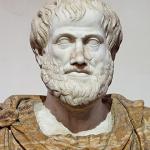
Aristotle was born in 384 BCE in Stagira, a small town on the northern coast of Greece. His father, Nicomachus, was the personal physician to King Amyntas of Macedon, which exposed Aristotle to the Macedonian court from an early age. Orphaned as a teenager, he was sent to Athens at the age of 17 to study at Plato’s Academy, where he remained for nearly 20 years. After Plato’s death in 347 BCE, Aristotle left Athens and traveled with other philosophers, including Xenocrates, before being invited by King Philip II of Macedon to tutor his son, Alexander, in 343 BCE. Aristotle returned to Athens in 335 BCE and founded his own school, the Lyceum, where he spent the next 12 years teaching, writing, and conducting research. After Alexander’s death in 323 BCE, anti-Macedonian sentiment in Athens led Aristotle to flee to Chalcis, where he died in 322 BCE at the age of 62.
Historical Context
Aristotle lived during the classical period of Ancient Greece, a time of intellectual flourishing and political upheaval. Athens, the center of Greek philosophy, had recently lost the Peloponnesian War to Sparta, leading to a period of instability. The rise of Macedon under Philip II and later Alexander the Great reshaped the Greek world, creating an empire that spread Greek culture across the Mediterranean and Near East. Aristotle’s work emerged from this environment, synthesizing earlier Greek thought while laying the groundwork for Western philosophy, science, and logic. His ideas influenced not only the Hellenistic world but also Islamic scholarship and medieval European thought, making him one of the most consequential figures in intellectual history.
Beliefs
- Empiricism: Aristotle believed knowledge comes from sensory experience and observation, contrasting with Plato’s theory of Forms.
- Teleology: He argued that all things have a purpose or final cause (telos), shaping his views on biology, ethics, and metaphysics.
- Virtue Ethics: He proposed that moral virtue is achieved through habit and the golden mean between extremes.
- Logic: He developed formal logic, including the syllogism, which became the foundation of Western logical systems.
- Politics: He believed the best political system balanced monarchy, aristocracy, and democracy, favoring a constitutional government.
Key Achievements
- Founded the Lyceum, a major philosophical school in Athens that emphasized empirical research and systematic study.
- Wrote over 200 works, covering logic, metaphysics, ethics, politics, biology, physics, poetry, and rhetoric, though only about 30 survive.
- Developed formal logic, including the syllogism, which became the basis for deductive reasoning in Western thought.
- Pioneered biology and zoology, classifying over 500 animal species and conducting detailed anatomical studies.
- Influenced Western science and philosophy, shaping medieval Islamic and Christian scholarship, particularly through Thomas Aquinas.
- Tutored Alexander the Great, whose conquests spread Greek culture and ideas across the known world, indirectly amplifying Aristotle’s influence.
- Established the foundations of ethics, with works like Nicomachean Ethics shaping moral philosophy for centuries.
- Contributed to political theory, with Politics analyzing different forms of government and their strengths and weaknesses.