Links
Life events
Wikipedia ↗
Wikipedia ↗
Wikipedia ↗
Wikipedia ↗
Wikipedia ↗
Wikipedia ↗
Wikipedia ↗
Wikipedia ↗
Wikipedia ↗
Wikipedia ↗
Article
Life Summary
Ashurnasirpal II (Aššur-nāṣir-apli II) was the king of Assyria from 883 to 859 BCE. He was the son of Tukulti-Ninurta II and ascended the throne following his father's death. His reign marked a period of significant expansion and consolidation of the Assyrian Empire. Ashurnasirpal II is renowned for his military prowess and the brutal tactics he employed to subdue rebellious regions and expand Assyrian territory. He conducted numerous campaigns across Mesopotamia, the Levant, and Anatolia, securing resources and tribute for Assyria.
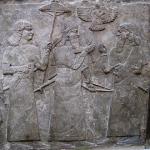
Ashurnasirpal II moved the capital of Assyria from Assur to the city of Kalhu (modern Nimrud), where he embarked on an extensive building program. He constructed a grand palace adorned with intricate reliefs depicting his military victories and hunting expeditions. His reign also saw advancements in administration and infrastructure, including the construction of roads and canals.
Ashurnasirpal II died in 859 BCE, and his son Shalmaneser III succeeded him. His legacy is characterized by both his military conquests and his contributions to Assyrian art and architecture.
Historical Context
Ashurnasirpal II ruled during the Neo-Assyrian Empire, a period marked by Assyria's rise as a dominant power in the ancient Near East. The empire had recently emerged from a period of decline and was in the process of reasserting its control over neighboring regions. Ashurnasirpal II's campaigns were part of a broader strategy to secure Assyria's borders, gain access to vital trade routes, and accumulate wealth through tribute and plunder.
The king's brutal tactics, including mass deportations and public displays of violence, were intended to instill fear and deter rebellion. These methods were effective in maintaining Assyrian dominance but also contributed to the empire's reputation for ruthlessness. Ashurnasirpal II's reign set the stage for further Assyrian expansion under his successors, culminating in the empire's peak during the 7th century BCE.
Ashurnasirpal II's building projects, particularly the construction of Nimrud, reflected the empire's growing wealth and power. The city became a center of political, economic, and cultural activity, showcasing Assyrian art and architecture. His reign is also notable for the detailed records and inscriptions he left behind, providing valuable insights into Assyrian history and society.
Beliefs
Ashurnasirpal II, like other Assyrian kings, was a devout follower of the Assyrian religion. He believed in the supremacy of the god Ashur, the patron deity of Assyria, and saw himself as Ashur's representative on Earth. His military campaigns were often framed as holy wars, undertaken to expand the territory under Ashur's dominion and to punish those who resisted Assyrian rule. The king's inscriptions frequently invoke the gods' support for his actions, emphasizing the divine mandate behind his conquests.
Key Achievements
- Expanded the Assyrian Empire through military campaigns in Mesopotamia, the Levant, and Anatolia.
- Established Kalhu (Nimrud) as the new capital of Assyria and oversaw its extensive development.
- Constructed a grand palace in Nimrud, adorned with detailed reliefs depicting his military victories and hunting scenes.
- Implemented administrative reforms and improved infrastructure, including roads and canals.
- Secured vast amounts of tribute and resources from conquered regions, enriching the Assyrian treasury.
- Left behind detailed inscriptions and records, providing valuable historical and cultural insights.
- Strengthened Assyria's military and political dominance, paving the way for further expansion under his successors.