Links
Life events
31 BC
Adoption by Tiberius and return to Rome
Tiberius adopted Caligula as his heir, bringing him back to Rome. Caligula was groomed for succession alongside Tiberius Gemellus, though their relationship was fraught with tension.
Tiberius adopted Caligula as his heir, bringing him back to Rome. Caligula was groomed for succession alongside Tiberius Gemellus, though their relationship was fraught with tension.
Wikipedia ↗
29 BC
Exile on the Island of Capri
Caligula was sent to live with Tiberius on the island of Capri, where he endured years of isolation and psychological manipulation. This period shaped his later erratic behavior as emperor.
Caligula was sent to live with Tiberius on the island of Capri, where he endured years of isolation and psychological manipulation. This period shaped his later erratic behavior as emperor.
Wikipedia ↗
19 BC
Death of Germanicus in Antioch
Germanicus died in Antioch under mysterious circumstances, widely believed to have been poisoned. This event deeply affected Caligula and fueled his later paranoia and distrust of the Roman elite.
Germanicus died in Antioch under mysterious circumstances, widely believed to have been poisoned. This event deeply affected Caligula and fueled his later paranoia and distrust of the Roman elite.
Wikipedia ↗
19 BC
Return to Rome after Germanicus' death
After his father's death, Caligula returned to Rome with his mother and siblings. His family fell out of favor with Emperor Tiberius, leading to a period of exile and hardship.
After his father's death, Caligula returned to Rome with his mother and siblings. His family fell out of favor with Emperor Tiberius, leading to a period of exile and hardship.
Wikipedia ↗
12 BC
Birth in Rome
Gaius Julius Caesar Augustus Germanicus, known as Caligula, was born in Antium (modern Anzio) but raised in Rome. He was the son of the popular Roman general Germanicus and Agrippina the Elder.
Gaius Julius Caesar Augustus Germanicus, known as Caligula, was born in Antium (modern Anzio) but raised in Rome. He was the son of the popular Roman general Germanicus and Agrippina the Elder.
Wikipedia ↗
4 BC
Accompanied Germanicus to Syria
Caligula traveled with his father, Germanicus, to the eastern provinces, including Syria, where Germanicus was sent to resolve political disputes. This journey exposed Caligula to military and political life from a young age.
Caligula traveled with his father, Germanicus, to the eastern provinces, including Syria, where Germanicus was sent to resolve political disputes. This journey exposed Caligula to military and political life from a young age.
Wikipedia ↗
AD 37
Accession as Roman Emperor
After the death of Tiberius, Caligula was proclaimed emperor by the Praetorian Guard. His early reign was marked by popularity, as he granted bonuses to the military and held lavish public games.
After the death of Tiberius, Caligula was proclaimed emperor by the Praetorian Guard. His early reign was marked by popularity, as he granted bonuses to the military and held lavish public games.
Wikipedia ↗
AD 37
Illness and shift in behavior
After a severe illness, Caligula's behavior became increasingly erratic and tyrannical. He demanded divine honors, executed rivals, and drained the treasury with extravagant projects.
After a severe illness, Caligula's behavior became increasingly erratic and tyrannical. He demanded divine honors, executed rivals, and drained the treasury with extravagant projects.
Wikipedia ↗
AD 39
Bridge of Boats across the Bay of Baiae
Caligula ordered the construction of a floating bridge across the Bay of Baiae, stretching over 2 miles, to fulfill a prophecy and demonstrate his power. He rode across it in a chariot.
Caligula ordered the construction of a floating bridge across the Bay of Baiae, stretching over 2 miles, to fulfill a prophecy and demonstrate his power. He rode across it in a chariot.
Wikipedia ↗
AD 41
Assassination in Rome
Caligula was assassinated by members of the Praetorian Guard, led by Cassius Chaerea. His wife and daughter were also killed. His death marked the end of his tumultuous and controversial reign.
Caligula was assassinated by members of the Praetorian Guard, led by Cassius Chaerea. His wife and daughter were also killed. His death marked the end of his tumultuous and controversial reign.
Wikipedia ↗
Article
Life Summary
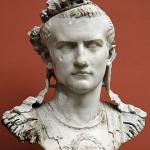
Gaius Julius Caesar Augustus Germanicus, known as Caligula, was born on August 31, 12 CE, in Antium, Italy. The son of the popular Roman general Germanicus and Agrippina the Elder, he was nicknamed "Caligula" (meaning "little boot") by soldiers during his childhood. After his father's mysterious death in 19 CE, Caligula lived with his great-uncle Tiberius, surviving the treacherous political climate of the imperial court. Upon Tiberius's death in 37 CE, Caligula became emperor at the age of 24, initially celebrated for his youth and the memory of his father.
Caligula's early reign was marked by generosity, such as public games and financial relief for citizens. However, after a severe illness in 37 CE, his behavior reportedly became erratic and tyrannical. Historical accounts, primarily from Suetonius and Tacitus, describe his cruelty, sexual excesses, and megalomania. He allegedly declared himself a god, demanded divine honors, and engaged in sadistic punishments of senators and rivals. His reign saw financial mismanagement, including the depletion of the treasury through lavish projects like floating bridges and palaces.
Caligula's rule ended violently on January 24, 41 CE, when he was assassinated by members of the Praetorian Guard, led by Cassius Chaerea. His wife Caesonia and daughter Julia Drusilla were also killed. The Senate initially considered restoring the Republic but ultimately accepted Claudius, Caligula's uncle, as the new emperor.
Historical Context
Caligula's reign occurred during the early Roman Empire, a period of transition from the Republic to autocratic rule. The Julio-Claudian dynasty, founded by Augustus, was consolidating power, and the emperor's authority was increasingly absolute. Caligula's rule exemplified the dangers of unchecked imperial power, where the whims of a single individual could dictate the fate of an empire. His reign highlighted the tensions between the emperor and the Senate, as well as the precarious position of the imperial family.
Caligula's alleged madness and cruelty have been debated by historians. Some suggest his behavior was a response to the political intrigues and betrayals he faced, while others argue he suffered from mental illness. Regardless, his reign left a lasting impression on Roman history, serving as a cautionary tale about the perils of absolute power and the fragility of imperial stability.
Key Achievements
- Early Popularity: Initially gained public favor through generous policies, such as tax reforms and public spectacles, including gladiatorial games and chariot races.
- Infrastructure Projects: Commissioned ambitious construction projects, including aqueducts (Aqua Claudia and Anio Novus) and the expansion of ports in Sicily and Regium.
- Military Campaigns: Led a symbolic campaign to Britain in 40 CE, though it resulted in little more than a beach landing and the collection of seashells as "spoils of war."
- Cultural Patronage: Supported the arts and public entertainment, including the construction of theaters and the promotion of Greek-style festivals.
- Administrative Reforms: Attempted to centralize power by reducing the influence of the Senate and increasing the role of the imperial bureaucracy.
- Religious Innovations: Promoted the cult of the emperor, declaring himself a living god and demanding divine honors, which alienated traditional Roman religious sensibilities.