Links
Life events
340 BC
Issue of Gold Coins
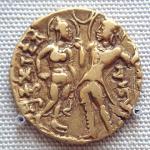
Chandragupta I issued gold coins featuring himself and his queen, Kumaradevi, symbolizing the prosperity and stability of the Gupta Empire.
Chandragupta I issued gold coins featuring himself and his queen, Kumaradevi, symbolizing the prosperity and stability of the Gupta Empire.
Wikipedia ↗
335 BC
Control over Mathura
Chandragupta I extended his empire to include Mathura, a key cultural and economic center in northern India.
Chandragupta I extended his empire to include Mathura, a key cultural and economic center in northern India.
Wikipedia ↗
335 BC
Death in Pataliputra
Chandragupta I died in Pataliputra, leaving behind a powerful and expanding Gupta Empire. His son, Samudragupta, succeeded him and further enlarged the empire.
Chandragupta I died in Pataliputra, leaving behind a powerful and expanding Gupta Empire. His son, Samudragupta, succeeded him and further enlarged the empire.
Wikipedia ↗
330 BC
Capture of Prayaga
Chandragupta I captured Prayaga (modern Prayagraj), a strategically important city, further expanding the Gupta Empire's territory.
Chandragupta I captured Prayaga (modern Prayagraj), a strategically important city, further expanding the Gupta Empire's territory.
Wikipedia ↗
325 BC
Conquest of Saketa
Chandragupta I expanded the Gupta Empire by conquering Saketa (modern Ayodhya), consolidating his control over northern India.
Chandragupta I expanded the Gupta Empire by conquering Saketa (modern Ayodhya), consolidating his control over northern India.
Wikipedia ↗
320 BC
Coronation as Maharajadhiraja
Chandragupta I ascended the throne and assumed the title of Maharajadhiraja (King of Kings), marking the formal establishment of the Gupta Empire.
Chandragupta I ascended the throne and assumed the title of Maharajadhiraja (King of Kings), marking the formal establishment of the Gupta Empire.
Wikipedia ↗
305 BC
Marriage to Kumaradevi
Chandragupta I married Kumaradevi, a Licchavi princess, which strengthened his political alliances and provided him with significant resources to expand his influence.
Chandragupta I married Kumaradevi, a Licchavi princess, which strengthened his political alliances and provided him with significant resources to expand his influence.
Wikipedia ↗
280 BC
Birth in Pataliputra
Chandragupta I was born in Pataliputra, the capital of the Magadha kingdom, into the Gupta dynasty. His early life is not well-documented, but he later became a pivotal figure in establishing the Gupta Empire.
Chandragupta I was born in Pataliputra, the capital of the Magadha kingdom, into the Gupta dynasty. His early life is not well-documented, but he later became a pivotal figure in establishing the Gupta Empire.
Wikipedia ↗
Article
Life Summary
Chandragupta I was born around 305 CE, the son of Gupta dynasty's king Ghatotkacha. He ascended to the throne around 320 CE and significantly expanded his kingdom through strategic alliances and military conquests. His marriage to Licchavi princess Kumaradevi, a powerful alliance, strengthened his position and resources. Chandragupta I ruled over a vast territory, including present-day northern India, and established his capital at Pataliputra. He is believed to have died around 335 CE, succeeded by his son Samudragupta, who further expanded the Gupta Empire.
Historical Context
Chandragupta I's reign marked the beginning of the Gupta Empire, often referred to as the Golden Age of India. This era saw significant advancements in arts, science, literature, and philosophy. The Gupta Empire provided stability and prosperity, fostering cultural and intellectual growth. Chandragupta I's strategic alliances and military prowess set the stage for his successors to build one of the most influential empires in Indian history. His reign is crucial for understanding the political and cultural landscape of ancient India.
Beliefs
Chandragupta I, like many rulers of his time, was likely a follower of Hinduism, which was the predominant religion in the region. The Gupta Empire is known for its patronage of Hindu culture and traditions, although it also promoted religious tolerance and supported Buddhist and Jain communities.
Key Achievements
- Founded the Gupta Empire, initiating a period of prosperity and cultural flourishing in India.
- Expanded the kingdom through strategic marriage alliances, particularly with the Licchavi clan.
- Established Pataliputra as the capital of the Gupta Empire.
- Laid the groundwork for the territorial expansion achieved by his successors, particularly Samudragupta.
- Promoted a stable and centralized administration that facilitated economic growth and cultural development.
- Initiated the Gupta Era, a calendar system starting from his coronation year (320 CE), which became significant in Indian chronology.