Links
Life events
Wikipedia ↗
Wikipedia ↗
Wikipedia ↗
Wikipedia ↗
Wikipedia ↗
Wikipedia ↗
Wikipedia ↗
Wikipedia ↗
Wikipedia ↗
Wikipedia ↗
Article
Life Summary
Chandragupta II, also known as Chandragupta Vikramaditya, was one of the most powerful emperors of the Gupta Empire in northern India. Born around 380 CE as the son of Emperor Samudragupta, he ascended to the throne after a succession struggle, possibly around 375 CE. His reign, which lasted until approximately 413 or 415 CE, marked the peak of the Gupta Empire's territorial expansion, wealth, and cultural flourishing. Chandragupta II is believed to have married Princess Kubera-naga of the Naga dynasty, which strengthened his political alliances. He further expanded his empire through military conquests, notably defeating the Western Kshatrapas and securing control over western India, including the prosperous ports of Gujarat. His capital at Pataliputra (modern-day Patna) and the city of Ujjain became centers of learning, art, and trade. Chandragupta II is also associated with the legendary Navaratnas (nine gems), a group of nine extraordinary scholars and poets at his court, including the renowned Sanskrit poet Kalidasa. He died around 413-415 CE, succeeded by his son Kumaragupta I.
Historical Context
Chandragupta II ruled during the Gupta Empire's golden age, a period often referred to as the "Classical Age" of India. This era saw remarkable advancements in science, mathematics, astronomy, literature, and art, with Indian culture exerting influence across Asia. The Gupta Empire was a beacon of stability and prosperity, fostering trade with the Roman Empire, Southeast Asia, and China. Chandragupta II's military campaigns, particularly his conquest of the Western Kshatrapas, secured vital trade routes and access to the Arabian Sea, boosting the empire's economy. His reign is also noted for religious tolerance, with Hinduism, Buddhism, and Jainism coexisting peacefully. The cultural and political achievements of his era laid the foundation for India's enduring legacy in the fields of philosophy, science, and the arts. Chandragupta II's rule is often compared to that of Ashoka the Great, as both emperors presided over periods of unprecedented cultural and territorial expansion.
Beliefs
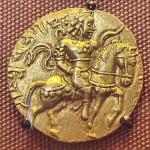
Chandragupta II was a devout Hindu, particularly worshipping Vishnu, as evidenced by his adoption of the title "Vikramaditya" (Sun of Valour) and the issuance of silver coins depicting him as a warrior. However, his court and empire were characterized by religious tolerance, with patronage extended to Buddhism and Jainism. This inclusive approach helped maintain social harmony and allowed diverse cultural and intellectual traditions to flourish. His reign saw the construction of numerous temples and the promotion of Sanskrit literature, reflecting his commitment to Hindu cultural revival while respecting other faiths.
Key Achievements
- Military Expansion: Successfully conquered the Western Kshatrapas, extending Gupta control over western India and securing vital trade routes to the Arabian Sea.
- Economic Prosperity: Fostered a thriving economy through trade with the Roman Empire, Southeast Asia, and China, facilitated by access to western ports.
- Cultural Patronage: Presided over a golden age of Indian culture, with his court hosting the legendary Navaratnas, including the poet Kalidasa.
- Architectural and Artistic Flourishing: Oversaw the construction of temples and the creation of exquisite art, including the famous Iron Pillar of Delhi, which bears his inscriptions.
- Religious Tolerance: Promoted a policy of religious inclusivity, allowing Hinduism, Buddhism, and Jainism to coexist and thrive.
- Diplomatic Alliances: Strengthened the empire through strategic marriages, such as his union with Princess Kubera-naga of the Naga dynasty.
- Administration: Established a well-organized and efficient administrative system that contributed to the empire's stability and prosperity.
- Legacy: His reign is often regarded as the pinnacle of the Gupta Empire, setting a benchmark for cultural and political achievements in ancient India.