Links
Life events
Wikipedia ↗
Wikipedia ↗
Wikipedia ↗
Wikipedia ↗
Wikipedia ↗
Wikipedia ↗
Wikipedia ↗
Wikipedia ↗
Wikipedia ↗
Article
Life Summary
Charlemagne, also known as Charles the Great, was born on April 2, 742, or possibly 747 or 748, in what is now modern-day Belgium, France, or Germany. He was the eldest son of Pepin the Short, the first Carolingian king of the Franks, and Bertrada of Laon. Upon his father's death in 768, Charlemagne and his brother Carloman inherited the Frankish kingdom. After Carloman's death in 771, Charlemagne became the sole ruler of the Franks.
Charlemagne's reign was marked by numerous military campaigns aimed at expanding and consolidating his empire. He conducted over 50 campaigns, including wars against the Lombards, Saxons, Avars, and Moors. His most notable conquest was the subjugation of the Saxons, which took over 30 years and involved forced Christianization. In 774, he conquered the Lombard Kingdom in Italy and assumed the title of King of the Lombards. In 800, Pope Leo III crowned him Emperor of the Romans, reviving the imperial title in the West.
Charlemagne was a patron of learning and the arts, initiating the Carolingian Renaissance, a period of cultural and intellectual revival in Europe. He established schools, promoted the copying of classical texts, and reformed the script used in manuscripts, leading to the development of the Carolingian minuscule. Charlemagne married multiple times and had numerous children. He died on January 28, 814, in Aachen, and was buried in the Aachen Cathedral.
Historical Context
Charlemagne's reign occurred during the early Middle Ages, a period often characterized by fragmentation and decline following the fall of the Western Roman Empire. Europe was divided into numerous small kingdoms and principalities, with the Frankish kingdom being one of the most powerful. The Catholic Church played a significant role in politics and society, and the papacy sought to assert its authority in both spiritual and temporal matters.
Charlemagne's empire, known as the Carolingian Empire, encompassed much of Western and Central Europe. His coronation as Emperor of the Romans by the Pope in 800 symbolized the alliance between the Frankish monarchy and the papacy, setting a precedent for the Holy Roman Empire. This event also marked the beginning of a power struggle between the papacy and secular rulers that would continue for centuries.
The Carolingian Renaissance, initiated by Charlemagne, was a crucial period of cultural revival that preserved and transmitted classical knowledge to later generations. This intellectual movement laid the groundwork for the later medieval renaissances and the eventual emergence of the modern Western world.
Beliefs
Charlemagne was a devout Christian and saw himself as a defender of the Church. He believed in the importance of Christian education and the spread of Christianity throughout his empire. His forced conversion of the Saxons and other pagan peoples reflected his conviction that Christianity was essential for the unity and stability of his realm. Charlemagne also believed in the divine right of kings and saw his imperial coronation as a sign of God's favor.
Key Achievements
- Military Conquests: Expanded the Frankish kingdom into a vast empire covering much of Western and Central Europe through numerous military campaigns.
- Imperial Coronation: Crowned Emperor of the Romans by Pope Leo III in 800, reviving the imperial title in the West and establishing the Holy Roman Empire.
- Carolingian Renaissance: Initiated a cultural and intellectual revival, promoting education, the arts, and the preservation of classical texts.
- Administrative Reforms: Established a centralized administration, dividing his empire into counties governed by counts, and implemented the missi dominici, royal envoys who supervised local governance.
- Legal Reforms: Promoted the codification of laws and the standardization of legal practices throughout his empire.
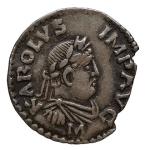
- Economic Reforms: Introduced a new coinage system based on the silver denier, which facilitated trade and economic growth.
- Religious Reforms: Strengthened the Church's infrastructure, promoted Christian education, and enforced the Christianization of conquered peoples.
- Cultural Patronage: Supported scholars, artists, and architects, leading to the construction of notable buildings such as the Palatine Chapel in Aachen.