Links
Life events
Wikipedia ↗
Wikipedia ↗
Wikipedia ↗
Wikipedia ↗
Wikipedia ↗
Wikipedia ↗
Article
Life Summary
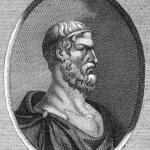
Draco was the first recorded legislator of Athens in Ancient Greece. Little is known about his early life, but he is believed to have been an aristocrat. Around 621 BCE, Draco was tasked with codifying and reforming Athenian law, which until then had been oral and subject to interpretation by aristocratic judges. His legal code was notorious for its severity, prescribing the death penalty for even minor offenses, such as stealing a cabbage. This harshness gave rise to the term "draconian" to describe unusually severe laws or measures. Draco’s laws were written in blood rather than ink, according to later sources. Beyond his legal reforms, little is known about his later life or death. Some traditions suggest he died in a peculiar manner—suffocated by an overwhelming number of cloaks and hats thrown upon him by admirers in the theater of Aegina.
Historical Context
Draco lived during the 7th century BCE, a period of significant social and political upheaval in Athens. The city-state was transitioning from an aristocratic rule to a more democratic system, though true democracy would not emerge until the reforms of Solon and Cleisthenes. Before Draco, Athenian laws were unwritten and administered by aristocratic judges, leading to inconsistencies and perceived injustices. The lower classes, or thetes, demanded written laws to limit the arbitrary power of the aristocracy. Draco’s legal code was a response to these demands, though his reforms ultimately failed to address the underlying social tensions. His laws were later largely repealed by Solon, who introduced more moderate reforms. Despite their harshness, Draco’s laws marked a critical step toward the rule of law in Athens, laying the groundwork for future democratic developments.
Beliefs
Draco’s legal code reflects a belief in strict justice and the need for written laws to curb the power of the aristocracy. His laws were designed to apply equally to all citizens, though in practice, they disproportionately affected the lower classes. There is no evidence that Draco held any particular philosophical or religious beliefs beyond the conventional Athenian polytheism of his time. His primary focus appears to have been on establishing order and consistency in Athenian governance.
Key Achievements
- Codification of Athenian Law: Draco was the first to write down Athenian laws, replacing the oral tradition that had been subject to aristocratic interpretation.
- Establishment of Legal Consistency: His laws aimed to create a uniform legal system, reducing arbitrary judgments by aristocratic judges.
- Introduction of Homicide Laws: Draco distinguished between intentional and unintentional homicide, a significant legal development that influenced later Greek and Roman law.
- Foundation for Future Reforms: Though his laws were later repealed, Draco’s efforts paved the way for Solon’s more moderate and democratic reforms.
- Cultural Impact: The term "draconian" originates from his name, symbolizing the severity of his legal code and influencing modern legal and political discourse.