Links
Life events
AD 569
Birth in Chang'an
Emperor Yang of Sui, born Yang Guang, was born in Chang'an, the capital of the Northern Zhou dynasty. He was the second son of Emperor Wen of Sui and Empress Dugu Qieluo.
Emperor Yang of Sui, born Yang Guang, was born in Chang'an, the capital of the Northern Zhou dynasty. He was the second son of Emperor Wen of Sui and Empress Dugu Qieluo.
Wikipedia ↗
AD 581
Appointment as Prince of Jin
Yang Guang was appointed Prince of Jin after his father, Yang Jian, founded the Sui dynasty and became Emperor Wen. This marked the beginning of his political ascent.
Yang Guang was appointed Prince of Jin after his father, Yang Jian, founded the Sui dynasty and became Emperor Wen. This marked the beginning of his political ascent.
Wikipedia ↗
AD 589
Conquest of Chen Dynasty in Jiankang
Yang Guang played a crucial role in the Sui dynasty's conquest of the Chen dynasty, leading to the reunification of China. The capital of Chen, Jiankang (modern Nanjing), fell to Sui forces.
Yang Guang played a crucial role in the Sui dynasty's conquest of the Chen dynasty, leading to the reunification of China. The capital of Chen, Jiankang (modern Nanjing), fell to Sui forces.
Wikipedia ↗
AD 604
Ascension to the Throne in Chang'an
After the death of Emperor Wen, Yang Guang ascended the throne as Emperor Yang of Sui in Chang'an. His reign marked a period of extensive public works and military campaigns.
After the death of Emperor Wen, Yang Guang ascended the throne as Emperor Yang of Sui in Chang'an. His reign marked a period of extensive public works and military campaigns.
Wikipedia ↗
AD 605
Construction of the Grand Canal Begins in Luoyang
Emperor Yang initiated the construction of the Grand Canal, one of the most ambitious infrastructure projects in Chinese history, connecting Luoyang to other key regions.
Emperor Yang initiated the construction of the Grand Canal, one of the most ambitious infrastructure projects in Chinese history, connecting Luoyang to other key regions.
Wikipedia ↗
AD 612
First Goguryeo Campaign
Emperor Yang launched the first of three failed military campaigns against Goguryeo (Korea). The campaign ended in a disastrous retreat, weakening the Sui dynasty.
Emperor Yang launched the first of three failed military campaigns against Goguryeo (Korea). The campaign ended in a disastrous retreat, weakening the Sui dynasty.
Wikipedia ↗
AD 613
Second Goguryeo Campaign from Jiangdu
Emperor Yang launched a second campaign against Goguryeo from Jiangdu (modern Yangzhou), but it was abandoned due to domestic rebellions and logistical failures.
Emperor Yang launched a second campaign against Goguryeo from Jiangdu (modern Yangzhou), but it was abandoned due to domestic rebellions and logistical failures.
Wikipedia ↗
AD 613
Rebellion of Yang Xuangan
Yang Xuangan, a disgruntled official, rebelled against Emperor Yang in Luoyang. The rebellion was quickly suppressed, but it marked the beginning of widespread unrest.
Yang Xuangan, a disgruntled official, rebelled against Emperor Yang in Luoyang. The rebellion was quickly suppressed, but it marked the beginning of widespread unrest.
Wikipedia ↗
AD 614
Third Goguryeo Campaign from Jiangdu
Emperor Yang launched a third and final campaign against Goguryeo from Jiangdu. It also ended in failure, further depleting the Sui dynasty's resources and morale.
Emperor Yang launched a third and final campaign against Goguryeo from Jiangdu. It also ended in failure, further depleting the Sui dynasty's resources and morale.
Wikipedia ↗
AD 616
Flight to Jiangdu
Facing widespread rebellions and the collapse of his empire, Emperor Yang fled to Jiangdu (modern Yangzhou), where he remained until his death.
Facing widespread rebellions and the collapse of his empire, Emperor Yang fled to Jiangdu (modern Yangzhou), where he remained until his death.
Wikipedia ↗
AD 618
Assassination in Jiangdu
Emperor Yang was strangled to death by his general, Yuwen Huaji, in Jiangdu. His death marked the end of the Sui dynasty and the rise of the Tang dynasty.
Emperor Yang was strangled to death by his general, Yuwen Huaji, in Jiangdu. His death marked the end of the Sui dynasty and the rise of the Tang dynasty.
Wikipedia ↗
Article
Life Summary
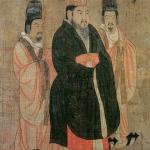
Emperor Yang of Sui, born Yang Guang (569 CE – 618 CE), was the second emperor of the Sui Dynasty, ruling from 604 to 618 CE. Born to Emperor Wen of Sui and Empress Dugu Qieluo, Yang Guang was initially the Prince of Jin. He played a crucial role in the reunification of China under his father's rule, particularly in the conquest of the Chen Dynasty in 589 CE. After his father's death—under disputed circumstances—Yang Guang ascended the throne in 604 CE.
Emperor Yang's reign was marked by ambitious infrastructure projects, including the construction of the Grand Canal, which connected northern and southern China, and the reconstruction of the Great Wall. He also relocated the capital from Chang'an to Luoyang. His military campaigns, particularly against the Goguryeo kingdom in Korea, drained the empire's resources and led to widespread discontent. His extravagant lifestyle and heavy taxation further alienated the populace. By 618 CE, rebellions had spread across the empire, and Emperor Yang was assassinated by his general, Yuwen Huaji, in Jiangdu (modern-day Yangzhou).
Historical Context
Emperor Yang ruled during a pivotal period in Chinese history, following the reunification of China after centuries of division under the Northern and Southern Dynasties. The Sui Dynasty, though short-lived, laid the groundwork for the Tang Dynasty, which would become one of China's golden ages. Emperor Yang's reign exemplified the challenges of consolidating power in a vast and diverse empire. His grandiose projects, while impressive, overextended the state's resources and contributed to the dynasty's rapid collapse. His military campaigns, particularly against Goguryeo, were costly failures that weakened the empire's stability. Despite his flaws, his infrastructure projects, such as the Grand Canal, had lasting benefits for China's economic and cultural integration.
Beliefs
Emperor Yang was a patron of Buddhism and promoted its spread across China, though his personal beliefs were likely influenced by political expediency as much as faith. He also adhered to Confucian principles of governance, emphasizing centralized control and bureaucratic efficiency. However, his autocratic rule and disregard for the welfare of his subjects contradicted Confucian ideals of benevolent leadership.
Key Achievements
- Construction of the Grand Canal: A massive infrastructure project that connected the Yellow and Yangtze Rivers, facilitating trade and communication between northern and southern China.
- Reconstruction of the Great Wall: Strengthened China's northern defenses, though at a high human and financial cost.
- Relocation of the Capital: Moved the capital from Chang'an to Luoyang, which became a cultural and political hub.
- Military Campaigns: Expanded Sui influence into Vietnam and Central Asia, though his campaigns against Goguryeo were disastrous.
- Legal and Administrative Reforms: Streamlined the bureaucracy and codified laws, influencing later dynasties.
- Promotion of Buddhism: Built temples and supported Buddhist institutions, aiding the religion's growth in China.
- Cultural Patronage: Encouraged literature, music, and the arts, fostering a vibrant cultural scene.
- Economic Policies: Standardized coinage and improved trade networks, though his heavy taxation burdened the populace.