Links
Life events
Wikipedia ↗
Wikipedia ↗
Wikipedia ↗
Wikipedia ↗
Wikipedia ↗
Wikipedia ↗
Wikipedia ↗
Wikipedia ↗
Article
Life Summary
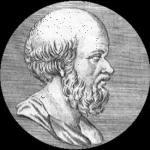
Eratosthenes of Cyrene was born around 276 BCE in Cyrene, a Greek colony in present-day Libya. He studied in Alexandria and later in Athens, where he was exposed to the philosophical schools of Plato and the Stoics. Around 245 BCE, he was invited by Ptolemy III Euergetes to return to Alexandria to become the chief librarian at the Library of Alexandria, a position he held for the remainder of his life. Eratosthenes was a polymath, contributing to mathematics, geography, astronomy, poetry, and philosophy. He died around 194 BCE in Alexandria, reportedly by voluntary starvation after going blind.
Historical Context
Eratosthenes lived during the Hellenistic period, a time of significant intellectual and cultural flourishing following the conquests of Alexander the Great. The Library of Alexandria was the center of learning in the ancient world, attracting scholars from various disciplines. This era was marked by advancements in science, mathematics, and geography, with scholars building upon the works of earlier Greek thinkers like Aristotle and Euclid. Eratosthenes' work exemplifies the Hellenistic spirit of inquiry and innovation, as he applied mathematical principles to solve real-world problems, such as measuring the Earth's size. His contributions laid the groundwork for future developments in geography and astronomy.
Beliefs
Eratosthenes was a rationalist who believed in the power of observation and mathematics to understand the natural world. He was critical of mythological explanations for natural phenomena and sought empirical evidence to support his theories. His work reflected the Hellenistic emphasis on practical applications of knowledge, bridging the gap between abstract philosophy and tangible science.
Key Achievements
- Measurement of the Earth's Circumference: Eratosthenes calculated the Earth's circumference with remarkable accuracy using the angles of the sun's rays at different locations (Syene and Alexandria) and basic geometry. His estimate was within 1-16% of the actual value.
- Sieve of Eratosthenes: Developed an algorithm for finding all prime numbers up to a specified integer, a method still taught in mathematics today.
- Geography: Wrote Geographica, a comprehensive treatise on the known world, including maps and descriptions of regions, climates, and cultures. He introduced the concept of latitude and longitude and created one of the earliest maps of the world.
- Chronology: Compiled a chronology of Greek history, dating events from the Trojan War to his own time, which became a foundational reference for later historians.
- Astronomy: Calculated the tilt of the Earth's axis and the distance from the Earth to the Sun, though his estimates were less accurate than his measurement of the Earth's circumference.
- Library of Alexandria: As chief librarian, he expanded the library's collections and fostered an environment of scholarly collaboration, making it the preeminent center of learning in the ancient world.