Links
Life events
Wikipedia ↗
Wikipedia ↗
Wikipedia ↗
Wikipedia ↗
Wikipedia ↗
Wikipedia ↗
Wikipedia ↗
Wikipedia ↗
Wikipedia ↗
Wikipedia ↗
Wikipedia ↗
Article
Life Summary
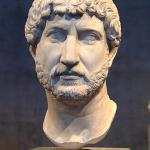
Publius Aelius Hadrianus Augustus, commonly known as Hadrian, was born on January 24, 76 CE, in Italica, Hispania Baetica (modern-day Spain). He was a member of a Roman family with deep roots in the Iberian Peninsula. Hadrian's early life was marked by his education in Rome, where he developed a keen interest in Greek culture, earning him the nickname "Graeculus" (Greekling).
Hadrian's political career began under the reign of Emperor Trajan, his cousin and predecessor. He served as a military tribune, quaestor, and later as governor of Syria. Upon Trajan's death in 117 CE, Hadrian was adopted posthumously as his successor, a move that was likely orchestrated by Trajan's wife, Plotina. Hadrian's reign began with the immediate consolidation of the Roman Empire's borders, abandoning Trajan's eastern conquests to stabilize the empire.
Hadrian spent more than half of his reign traveling across the empire, inspecting provinces, and overseeing administrative reforms. He was a patron of the arts and architecture, leaving a lasting legacy through projects like the Pantheon in Rome and Hadrian's Wall in Britain. His personal life was marked by his deep affection for Antinous, a young Greek man who drowned in the Nile in 130 CE, after which Hadrian deified him.
Hadrian's health declined in his later years, and he adopted Antoninus Pius as his successor, with the condition that Antoninus would in turn adopt Marcus Aurelius. Hadrian died on July 10, 138 CE, in Baiae, Italy, at the age of 62. He was buried in Rome, and his mausoleum, now known as Castel Sant'Angelo, stands as a testament to his legacy.
Historical Context
Hadrian ruled during the height of the Roman Empire, a period known as the Pax Romana. This era was characterized by relative peace and stability, allowing for significant cultural and architectural advancements. Hadrian's reign is often seen as a turning point, shifting from the expansionist policies of his predecessor Trajan to a focus on consolidation and defense. His travels across the empire were unprecedented for a Roman emperor and demonstrated his commitment to understanding and improving the lives of his subjects.
Hadrian's policies reflected a deep appreciation for Greek culture, which influenced his architectural projects and administrative reforms. His decision to build Hadrian's Wall in Britain marked a clear boundary for the empire, symbolizing the shift from expansion to consolidation. This wall not only served as a defensive structure but also as a symbol of Roman power and engineering prowess.
The era was also marked by significant intellectual and philosophical developments. Hadrian himself was a Stoic, and his reign saw the flourishing of Greek philosophy and literature within the Roman world. His deification of Antinous and the subsequent cult that developed around him also highlight the syncretism of Roman and Greek religious practices during this period.
Beliefs
Hadrian was a complex figure whose beliefs were shaped by his Stoic philosophy and his deep admiration for Greek culture. He was known for his intellectual pursuits, including poetry and philosophy, and he surrounded himself with scholars and artists. His Stoicism is evident in his approach to governance, emphasizing duty, reason, and self-discipline.
Hadrian's religious beliefs were syncretic, blending Roman and Greek traditions. He was particularly devoted to the cult of Antinous, whom he deified after his death. This act was not merely personal but also reflected Hadrian's desire to integrate Greek religious practices into the Roman imperial cult.
Key Achievements
- Hadrian's Wall: Constructed in northern Britain to mark the northern boundary of the Roman Empire and provide defense against northern tribes.
- Architectural Projects: Oversaw the reconstruction of the Pantheon in Rome, which remains one of the best-preserved ancient Roman buildings.
- Administrative Reforms: Consolidated and stabilized the Roman Empire, focusing on efficient governance and legal reforms.
- Travels Across the Empire: Spent more than half of his reign traveling, inspecting provinces, and ensuring the welfare of his subjects.
- Cultural Patronage: Promoted Greek culture and philosophy, fostering a period of intellectual and artistic flourishing.
- Military Consolidation: Abandoned Trajan's eastern conquests to strengthen the empire's existing borders, ensuring long-term stability.
- Legal Contributions: Codified Roman law, making it more accessible and uniform across the empire.
- Deification of Antinous: Established a cult around Antinous, integrating Greek religious practices into the Roman imperial cult.