Links
Life events
1,810 BC
Birth in Babylon
Hammurabi was born in Babylon, the son of Sin-Muballit, who was then the Amorite king of the First Babylonian Dynasty. His birth marked the beginning of a lineage that would later dominate Mesopotamia.
Hammurabi was born in Babylon, the son of Sin-Muballit, who was then the Amorite king of the First Babylonian Dynasty. His birth marked the beginning of a lineage that would later dominate Mesopotamia.
Wikipedia ↗
1,792 BC
Ascension to the Throne of Babylon
Hammurabi succeeded his father, Sin-Muballit, as the sixth king of the First Babylonian Dynasty. His early reign focused on consolidating power within Babylon and its immediate surroundings.
Hammurabi succeeded his father, Sin-Muballit, as the sixth king of the First Babylonian Dynasty. His early reign focused on consolidating power within Babylon and its immediate surroundings.
Wikipedia ↗
1,763 BC
Conquest of Larsa
Hammurabi defeated Rim-Sin I, the king of Larsa, after a prolonged conflict. This victory significantly expanded Babylonian control over southern Mesopotamia, including the important city of Ur.
Hammurabi defeated Rim-Sin I, the king of Larsa, after a prolonged conflict. This victory significantly expanded Babylonian control over southern Mesopotamia, including the important city of Ur.
Wikipedia ↗
1,762 BC
Conquest of Eshnunna
Hammurabi captured the city of Eshnunna, a major power in the Diyala River region. This victory further solidified Babylonian dominance in central Mesopotamia and eliminated a key rival.
Hammurabi captured the city of Eshnunna, a major power in the Diyala River region. This victory further solidified Babylonian dominance in central Mesopotamia and eliminated a key rival.
Wikipedia ↗
1,759 BC
Conquest of Mari
Hammurabi defeated Zimri-Lim, the king of Mari, and destroyed the city. This conquest extended Babylonian influence to the upper Euphrates region, completing Hammurabi's unification of Mesopotamia.
Hammurabi defeated Zimri-Lim, the king of Mari, and destroyed the city. This conquest extended Babylonian influence to the upper Euphrates region, completing Hammurabi's unification of Mesopotamia.
Wikipedia ↗
1,754 BC
Promulgation of the Code of Hammurabi
Hammurabi issued one of the earliest and most complete written legal codes, known as the Code of Hammurabi. The code was inscribed on a stele and displayed publicly, establishing laws and punishments for Babylonian society.
Hammurabi issued one of the earliest and most complete written legal codes, known as the Code of Hammurabi. The code was inscribed on a stele and displayed publicly, establishing laws and punishments for Babylonian society.
Wikipedia ↗
1,750 BC
Major Construction Projects in Babylon
Hammurabi oversaw extensive construction projects in Babylon, including the expansion of city walls, temples, and infrastructure. These projects reinforced Babylon's status as a major political and cultural center.
Hammurabi oversaw extensive construction projects in Babylon, including the expansion of city walls, temples, and infrastructure. These projects reinforced Babylon's status as a major political and cultural center.
Wikipedia ↗
1,750 BC
Death in Babylon
Hammurabi died in Babylon after a reign of 42 years. His death marked the end of a period of significant expansion and consolidation for the Babylonian Empire, which he had transformed into a dominant power in Mesopotamia.
Hammurabi died in Babylon after a reign of 42 years. His death marked the end of a period of significant expansion and consolidation for the Babylonian Empire, which he had transformed into a dominant power in Mesopotamia.
Wikipedia ↗
Article
Life Summary
Hammurabi was born around 1810 BCE in Babylon, a city-state in ancient Mesopotamia. He was the sixth king of the First Babylonian Dynasty, reigning from approximately 1792 BCE to 1750 BCE. His father, Sin-Muballit, was the fifth king of the dynasty, and Hammurabi ascended to the throne following his father's abdication. Early in his reign, Hammurabi focused on strengthening Babylon's infrastructure and military. He is best known for his military campaigns, which expanded Babylon's territory to include much of Mesopotamia, and for the establishment of the Code of Hammurabi, one of the earliest and most complete written legal codes. Hammurabi died around 1750 BCE, leaving behind a legacy as one of history's most influential rulers.
Historical Context
Hammurabi ruled during the Old Babylonian period, a time of significant political and cultural development in Mesopotamia. The region was characterized by city-states vying for power, and Hammurabi's reign marked the peak of Babylonian influence. His military conquests unified much of Mesopotamia under Babylonian rule, fostering economic and cultural exchange. The Code of Hammurabi, inscribed on a stele and displayed publicly, reflected the social hierarchies and legal principles of the time. It provided a framework for justice and governance that influenced subsequent legal systems. Hammurabi's reign is often seen as a golden age for Babylon, setting the stage for its enduring legacy in history.
Beliefs
Hammurabi was a devout follower of the Mesopotamian pantheon, particularly the god Marduk, whom he elevated to the supreme position in the Babylonian religion. His legal code was presented as divinely inspired, reflecting the belief that laws were handed down by the gods to ensure order and justice. The prologue and epilogue of the Code of Hammurabi emphasize the king's role as a shepherd chosen by the gods to bring prosperity and fairness to his people.
Key Achievements
- Code of Hammurabi: Created one of the earliest and most complete legal codes, consisting of 282 laws covering topics such as trade, property, family, and labor.
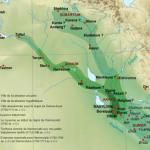
- Military Expansion: Conquered and unified much of Mesopotamia, including the city-states of Larsa, Eshnunna, and Mari, under Babylonian rule.
- Infrastructure Development: Improved Babylon's infrastructure, including the construction of temples, canals, and defensive walls.
- Economic Reforms: Standardized weights and measures, facilitating trade and economic stability within his empire.
- Cultural Patronage: Promoted arts and literature, contributing to the cultural flourishing of Babylon during his reign.
- Religious Reforms: Elevated Marduk to the head of the Babylonian pantheon, reinforcing Babylon's religious and political dominance.