Links
Life events
1,507 BC
Birth in Thebes
Hatshepsut was born in Thebes, the daughter of Pharaoh Thutmose I and his principal wife, Ahmose. She was of royal lineage, which later supported her claim to the throne.
Hatshepsut was born in Thebes, the daughter of Pharaoh Thutmose I and his principal wife, Ahmose. She was of royal lineage, which later supported her claim to the throne.
Wikipedia ↗
1,492 BC
Marriage to Thutmose II
Hatshepsut married her half-brother Thutmose II, consolidating her position within the royal family. This marriage was customary in Egyptian royal tradition to maintain dynastic purity.
Hatshepsut married her half-brother Thutmose II, consolidating her position within the royal family. This marriage was customary in Egyptian royal tradition to maintain dynastic purity.
Wikipedia ↗
1,479 BC
Regency for Thutmose III
After the death of Thutmose II, Hatshepsut became regent for her stepson Thutmose III, who was too young to rule. She effectively governed Egypt during this period.
After the death of Thutmose II, Hatshepsut became regent for her stepson Thutmose III, who was too young to rule. She effectively governed Egypt during this period.
Wikipedia ↗
1,478 BC
Coronation as Pharaoh
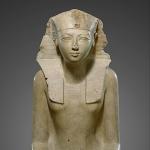
Hatshepsut declared herself pharaoh, adopting the full royal titulary and often depicted as a male king in art and inscriptions. She ruled as co-regent with Thutmose III.
Hatshepsut declared herself pharaoh, adopting the full royal titulary and often depicted as a male king in art and inscriptions. She ruled as co-regent with Thutmose III.
Wikipedia ↗
1,473 BC
Construction of Deir el-Bahari
Hatshepsut commissioned the construction of her mortuary temple at Deir el-Bahari, near Thebes. The temple is renowned for its architectural brilliance and detailed reliefs.
Hatshepsut commissioned the construction of her mortuary temple at Deir el-Bahari, near Thebes. The temple is renowned for its architectural brilliance and detailed reliefs.
Wikipedia ↗
1,470 BC
Expedition to Punt
Hatshepsut organized a famous trading expedition to the land of Punt, bringing back valuable goods such as myrrh, gold, and exotic animals. This expedition is depicted in her temple at Deir el-Bahari.
Hatshepsut organized a famous trading expedition to the land of Punt, bringing back valuable goods such as myrrh, gold, and exotic animals. This expedition is depicted in her temple at Deir el-Bahari.
Wikipedia ↗
1,468 BC
Military Campaigns in Nubia
Hatshepsut led military campaigns in Nubia to secure Egypt's southern borders and maintain control over valuable resources, including gold and trade routes.
Hatshepsut led military campaigns in Nubia to secure Egypt's southern borders and maintain control over valuable resources, including gold and trade routes.
Wikipedia ↗
1,465 BC
Construction of Obelisks at Karnak
Hatshepsut erected two massive obelisks at the Temple of Karnak in Thebes to celebrate her reign and honor the god Amun. One of these obelisks still stands today.
Hatshepsut erected two massive obelisks at the Temple of Karnak in Thebes to celebrate her reign and honor the god Amun. One of these obelisks still stands today.
Wikipedia ↗
1,458 BC
Death in Thebes
Hatshepsut died in Thebes after ruling Egypt for approximately 22 years. The exact cause of her death remains unknown, though theories include diabetes or cancer.
Hatshepsut died in Thebes after ruling Egypt for approximately 22 years. The exact cause of her death remains unknown, though theories include diabetes or cancer.
Wikipedia ↗
Article
Life Summary
Hatshepsut was born around 1507 BCE to Pharaoh Thutmose I and his principal wife, Ahmose. She was married to her half-brother, Thutmose II, and served as queen regent after his death while her stepson, Thutmose III, was a child. However, she soon assumed the full powers of a pharaoh, becoming one of Egypt’s few female rulers. Her reign lasted approximately 21 years, from 1478 to 1458 BCE, during which she adopted the full titulary of a king, including the male pronouns and regalia. Hatshepsut died around 1458 BCE, and her stepson, Thutmose III, succeeded her. After her death, many of her monuments were defaced or destroyed, possibly as an attempt to erase her legacy from history.
Historical Context
Hatshepsut ruled during the New Kingdom period of Ancient Egypt, a time of great prosperity, military expansion, and cultural flourishing. Egypt was a dominant power in the ancient world, and Hatshepsut’s reign is often regarded as a golden age. Her leadership was unconventional, as female rulers were rare in Egyptian history, and her assumption of power challenged traditional gender roles. Despite this, she maintained stability and expanded Egypt’s influence through trade and diplomacy rather than military conquest. Her reign is notable for its focus on economic prosperity, architectural innovation, and the restoration of trade networks disrupted during the Hyksos occupation. Hatshepsut’s legacy was later obscured, likely due to efforts by her successors to legitimize their own rule by erasing hers.
Beliefs
Hatshepsut justified her rule by claiming divine birth, asserting that she was the daughter of the god Amun. She used religious propaganda to legitimize her authority, portraying herself as the chosen ruler of Egypt. Her reign emphasized the importance of the gods, particularly Amun, and she commissioned numerous religious monuments and temples. Hatshepsut also promoted the idea of Ma’at (cosmic order, truth, and justice), which was central to Egyptian kingship. Her belief in her divine right to rule was a key factor in her ability to maintain power despite societal norms favoring male rulers.
Key Achievements
- Trade Expedition to Punt: Organized a famous and highly successful trade mission to the land of Punt, bringing back gold, myrrh, ebony, and exotic animals, which enriched Egypt’s economy and prestige.
- Architectural Legacy: Commissioned the construction of the Temple of Deir el-Bahri, a stunning mortuary temple designed by her architect Senenmut, which remains one of Egypt’s most iconic structures.
- Restoration of Monuments: Oversaw the restoration of temples and monuments damaged during the Hyksos occupation, including the Temple of Karnak.
- Military Campaigns: Maintained Egypt’s borders and conducted military campaigns in Nubia and Syria, ensuring the security and expansion of Egyptian influence.
- Economic Prosperity: Strengthened Egypt’s economy through trade, agriculture, and infrastructure projects, leading to a period of unprecedented wealth.
- Legitimization of Rule: Successfully established her authority as a female pharaoh by adopting male regalia, titles, and imagery, and by promoting her divine birth through propaganda.