Links
Life events
Wikipedia ↗
Wikipedia ↗
Wikipedia ↗
Wikipedia ↗
Wikipedia ↗
Wikipedia ↗
Article
Life Summary
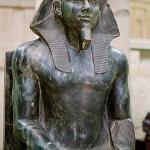
Khafre, also known as Khafra or Chephren, was an ancient Egyptian pharaoh who ruled during the Fourth Dynasty of the Old Kingdom, approximately from 2570 to 2532 BCE. He was the son of Pharaoh Khufu and the builder of the second-largest pyramid at Giza, known as the Pyramid of Khafre. His reign is often overshadowed by that of his father, but he is notable for his architectural contributions and the construction of the Great Sphinx, which is believed to bear his likeness.
Khafre ascended to the throne after the short reign of his elder brother Djedefre. His reign was marked by stability and prosperity, allowing him to undertake significant building projects. He married several wives, including Queen Meresankh III, and had multiple children, including his successor Menkaure. Khafre's mummy has never been conclusively identified, and the exact circumstances of his death remain unknown.
Historical Context
Khafre ruled during the height of the Old Kingdom, a period often referred to as the 'Age of the Pyramids.' This era was characterized by strong centralized government, economic prosperity, and monumental architectural achievements. The Fourth Dynasty saw the construction of some of the most iconic structures in ancient Egyptian history, including the Great Pyramids of Giza. Khafre's reign contributed significantly to this legacy, reinforcing the pharaoh's divine status and the power of the Egyptian state.
The Old Kingdom was a time of cultural and artistic flourishing. The pharaohs of this period were seen as living gods, and their monumental building projects served both as tombs and as symbols of their eternal power. Khafre's pyramid complex, which included temples and the Great Sphinx, was designed to ensure his immortality and demonstrate his divine authority. The Sphinx, in particular, has become an enduring symbol of ancient Egypt, reflecting the civilization's advanced engineering and artistic skills.
Beliefs
Khafre, like other pharaohs of the Old Kingdom, adhered to the religious beliefs of ancient Egypt, which centered around the worship of numerous deities and the concept of the afterlife. The pharaoh was considered a divine intermediary between the gods and the people, responsible for maintaining Ma'at, the cosmic order. Khafre's building projects, particularly his pyramid and temples, were designed to ensure his successful journey to the afterlife and his eternal rule as a god.
The construction of the Great Sphinx, often associated with the sun god Ra, reflects the importance of solar worship during Khafre's reign. The Sphinx's lion body and human head may symbolize the pharaoh's power and divine connection, serving as a guardian of the necropolis at Giza.
Key Achievements
- Pyramid of Khafre: Built the second-largest pyramid at Giza, which remains one of the most iconic structures of ancient Egypt.
- Great Sphinx: Commissioned the construction of the Great Sphinx, a monumental statue that has become a symbol of ancient Egyptian civilization.
- Temple Complexes: Constructed a valley temple and a mortuary temple as part of his pyramid complex, showcasing advanced architectural and engineering skills.
- Stability and Prosperity: Maintained political stability and economic prosperity during his reign, enabling large-scale building projects.
- Artistic Legacy: Contributed to the artistic and cultural flourishing of the Old Kingdom, leaving a lasting impact on Egyptian art and architecture.
- Dynastic Continuity: Ensured the continuation of the Fourth Dynasty by passing the throne to his son Menkaure, maintaining the stability of the Egyptian state.