Links
Life events
Wikipedia ↗
Wikipedia ↗
Wikipedia ↗
Wikipedia ↗
Wikipedia ↗
Wikipedia ↗
Wikipedia ↗
Article
Life Summary
Kumaragupta I, also known as Mahendraditya, was the son and successor of the Gupta Emperor Chandragupta II. He ascended the throne around 415 CE and ruled until approximately 455 CE. His reign marked a period of stability and continuity for the Gupta Empire, which was at its zenith during this era. Kumaragupta I is believed to have been born in the late 4th century CE, though exact details of his early life remain scarce. He maintained the empire's territorial integrity, which stretched across much of northern and central India, and continued the patronage of arts, sciences, and literature that characterized the Gupta dynasty. His death around 455 CE marked the end of a prosperous era, though the Gupta Empire persisted under his successors for some time before its eventual decline.
Historical Context
Kumaragupta I ruled during the golden age of the Gupta Empire, a period often referred to as the "Classical Age" of India. The Gupta dynasty, founded by Sri Gupta in the late 3rd century CE, had grown into a powerful empire under the leadership of Chandragupta I, Samudragupta, and Chandragupta II. This era was marked by significant advancements in science, mathematics, astronomy, literature, and art. The Gupta Empire was a hub of cultural and intellectual activity, with scholars like Aryabhata making groundbreaking contributions to mathematics and astronomy. Kumaragupta I's reign was crucial in maintaining the empire's stability and prosperity, allowing for the continuation of these cultural achievements. His rule also saw the empire facing external threats, such as invasions by the Pushyamitras and the Hunas, which would later intensify under his successors.
Beliefs
Kumaragupta I, like his predecessors, was a follower of Hinduism and patronized the religion extensively. The Gupta rulers were known for their support of Hindu temples, rituals, and scholarship, which played a significant role in the revival and systematization of Hinduism. Kumaragupta I is also associated with the worship of Lord Kartikeya (also known as Skanda or Mahasena), as evidenced by coins bearing the deity's image. The Gupta dynasty's religious policies were inclusive, and they also supported Buddhism and Jainism, contributing to the construction of monasteries and stupas.
Key Achievements
- Maintenance of the Gupta Empire's Stability: Kumaragupta I successfully preserved the territorial integrity and administrative efficiency of the Gupta Empire, ensuring continued prosperity.
- Cultural Patronage: He continued the Gupta tradition of supporting arts, literature, and sciences, fostering an environment where scholars and artists thrived.
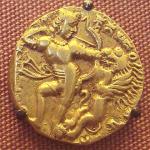
- Coinage and Economic Prosperity: Kumaragupta I issued a variety of gold coins, including those depicting himself as an archer and others featuring the deity Kartikeya, reflecting the empire's economic strength and artistic sophistication.
- Religious Contributions: He patronized Hinduism, Buddhism, and Jainism, contributing to the religious and cultural diversity of the empire.
- Military Campaigns: Kumaragupta I defended the empire against external threats, including the Pushyamitras, ensuring the safety and stability of his realm.
- Legacy of the Gupta Dynasty: His reign bridged the gap between the golden age of Chandragupta II and the later rulers, ensuring the continuity of Gupta achievements and influence.