Links
Life events
Wikipedia ↗
Wikipedia ↗
Wikipedia ↗
Wikipedia ↗
Wikipedia ↗
Wikipedia ↗
Wikipedia ↗
Wikipedia ↗
Wikipedia ↗
Wikipedia ↗
Wikipedia ↗
Wikipedia ↗
Article
Life Summary
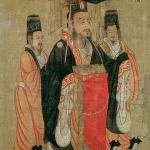
Liu Bei (161–223 CE) was a warlord and the founding emperor of the Shu Han state during China’s Three Kingdoms period. Born in Zhuo County (modern-day Zhuozhou, Hebei), he claimed descent from Emperor Jing of the Han dynasty. Orphaned at a young age, Liu Bei and his mother lived in poverty, selling sandals and woven mats to survive. Despite his humble beginnings, he was known for his ambition and charisma, attracting loyal followers like Guan Yu and Zhang Fei, who swore brotherhood with him in the Oath of the Peach Garden.
Liu Bei’s early military career was marked by instability, as he frequently switched allegiances between warlords like Cao Cao, Lü Bu, and Yuan Shao. His fortunes improved after forming an alliance with the warlord Sun Quan, leading to the decisive Battle of Red Cliffs (208 CE), where Cao Cao’s forces were defeated. This victory allowed Liu Bei to establish control over Jing Province and later expand into Yi Province (modern-day Sichuan). In 214 CE, he captured Yi Province from Liu Zhang, solidifying his power base. In 221 CE, he declared himself Emperor of Shu Han, claiming legitimacy as the successor to the Han dynasty. His reign was short-lived, however, as he died in 223 CE after a failed campaign against Sun Quan’s Eastern Wu, which resulted in the loss of Jing Province.
Historical Context
Liu Bei lived during the late Eastern Han dynasty and the Three Kingdoms period (220–280 CE), a time of immense political fragmentation and warfare in China. The Han dynasty, which had ruled for over 400 years, collapsed due to internal corruption, peasant uprisings (such as the Yellow Turban Rebellion), and the rise of regional warlords. The power vacuum led to a tripartite division of China among the states of Wei, Shu, and Wu, each vying for dominance. Liu Bei’s Shu Han positioned itself as the legitimate successor to the Han dynasty, appealing to Confucian ideals of loyalty and righteousness. His rivalry with Cao Cao, the de facto ruler of Wei, became legendary, immortalized in the 14th-century historical novel Romance of the Three Kingdoms. Liu Bei’s emphasis on virtue, loyalty, and benevolence contrasted with Cao Cao’s ruthless pragmatism, making him a symbol of Confucian ideals in Chinese culture.
Beliefs
Liu Bei was deeply influenced by Confucian values, particularly the concepts of ren (benevolence) and yi (righteousness). He portrayed himself as a protector of the Han legacy, often invoking the Mandate of Heaven to justify his rule. His governance style emphasized loyalty, humility, and the welfare of his people, though his reliance on these ideals sometimes clashed with the harsh realities of warfare and statecraft. He also valued personal relationships, as seen in his lifelong bond with Guan Yu and Zhang Fei, which became a model of brotherly loyalty in Chinese folklore.
Key Achievements
- Founded the Shu Han state (221 CE): Established one of the three major powers during the Three Kingdoms period, ruling over present-day Sichuan and parts of southern China.
- Alliance with Sun Quan: Formed a critical alliance with the warlord Sun Quan, leading to the victory at the Battle of Red Cliffs (208 CE), which crippled Cao Cao’s forces and secured Liu Bei’s territorial base.
- Capture of Yi Province (214 CE): Successfully conquered Yi Province (modern-day Sichuan), providing Shu Han with a defensible and resource-rich heartland.
- Promoted Confucian governance: Emphasized benevolent rule and loyalty, fostering a reputation as a virtuous leader in contrast to his rivals.
- Cultural legacy: His life and deeds were immortalized in Romance of the Three Kingdoms, one of China’s Four Great Classical Novels, shaping his image as an idealized ruler in Chinese literature and folklore.
- Military leadership: Led numerous campaigns, including the defense of Jing Province and the ill-fated expedition against Eastern Wu, demonstrating strategic acumen despite ultimate defeat.
- Recruitment of Zhuge Liang: Persuaded the brilliant strategist Zhuge Liang to join his cause, securing one of the most iconic advisor-leader partnerships in Chinese history.