Links
Life events
Wikipedia ↗
Wikipedia ↗
Wikipedia ↗
Article
Life Summary
Meskalamdug, whose name means "Hero of the Good Land," was an early ruler of the First Dynasty of Ur in ancient Mesopotamia, likely reigning around the 26th century BCE. Little is known about his early life, but he is primarily remembered for his lavish royal tomb, discovered in the Royal Cemetery at Ur by British archaeologist Sir Leonard Woolley in the 1920s. His tomb, designated PG 755, contained a wealth of artifacts, including gold helmets, jewelry, and other precious items, indicating his high status. The exact circumstances of his death remain unclear, but the richness of his burial suggests he was a significant figure in early Sumerian society.
Historical Context
Meskalamdug lived during the Early Dynastic Period of Mesopotamia, a time of emerging city-states and the development of early writing, complex religious practices, and monumental architecture. Ur was one of the most prominent cities in Sumer, and its rulers played a crucial role in the political and cultural landscape of the region. The discovery of Meskalamdug’s tomb provided invaluable insights into the burial practices, craftsmanship, and social hierarchy of early Mesopotamian civilization. His reign occurred during a period of competition and conflict among Sumerian city-states, which would later culminate in the rise of the Akkadian Empire under Sargon of Akkad. Meskalamdug’s significance lies in his representation of early kingship and the material culture of Ur during this formative era.
Beliefs
Meskalamdug, like other Sumerian rulers, likely adhered to the polytheistic religious beliefs of Mesopotamia. The Sumerians worshipped a pantheon of gods, including An (sky god), Enlil (god of wind and storms), Inanna (goddess of love and war), and Nanna (moon god, patron deity of Ur). Kings were often seen as intermediaries between the gods and the people, responsible for maintaining cosmic order and ensuring the prosperity of their city. The elaborate burial goods in Meskalamdug’s tomb suggest a belief in an afterlife where the deceased would continue to require earthly possessions and status symbols.
Key Achievements
- Royal Tomb at Ur: His tomb (PG 755) is one of the most famous discoveries in the Royal Cemetery of Ur, providing critical evidence of early Sumerian burial practices and craftsmanship.
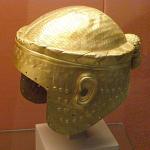
- Gold Helmet: The discovery of a gold helmet in his tomb, inscribed with his name, is one of the earliest known examples of royal regalia in Mesopotamia.
- Contribution to Early Kingship: Meskalamdug’s reign exemplifies the early development of kingship in Sumer, where rulers were both political and religious leaders.
- Cultural Patronage: The artifacts in his tomb, including jewelry, weapons, and musical instruments, highlight the advanced artistic and technological skills of Ur’s craftsmen during his time.
- Legacy in Archaeology: His tomb’s discovery significantly advanced the understanding of early Mesopotamian civilization, particularly in terms of social hierarchy and material culture.