Links
Life events
Wikipedia ↗
Wikipedia ↗
Wikipedia ↗
Wikipedia ↗
Wikipedia ↗
Wikipedia ↗
Wikipedia ↗
Wikipedia ↗
Wikipedia ↗
Wikipedia ↗
Wikipedia ↗
Article
Life Summary
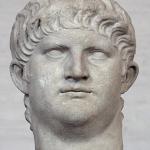
Nero Claudius Caesar Augustus Germanicus, born Lucius Domitius Ahenobarbus on December 15, 37 CE, was the fifth Roman Emperor, ruling from 54 CE until his death in 68 CE. He was the son of Gnaeus Domitius Ahenobarbus and Agrippina the Younger, who later married her uncle, Emperor Claudius. Agrippina orchestrated Nero’s adoption by Claudius, securing his position as heir to the throne. Upon Claudius’s death in 54 CE—widely believed to have been poisoned by Agrippina—Nero ascended to power at the age of 16, initially under the guidance of his mother, the philosopher Seneca, and the praetorian prefect Burrus.
Nero’s early reign was marked by relative stability and prosperity, with a focus on diplomacy, trade, and cultural pursuits. However, his relationship with Agrippina deteriorated as he sought independence from her influence. In 59 CE, he allegedly orchestrated her murder, along with the deaths of his first wife, Octavia, and his stepbrother Britannicus. Nero’s personal life became increasingly erratic; he married Poppaea Sabina in 62 CE after divorcing and exiling Octavia, and later kicked Poppaea to death while she was pregnant in 65 CE.
Nero’s reign is infamous for the Great Fire of Rome in 64 CE, which destroyed much of the city. Though Nero was rumored to have started the fire to clear land for his architectural projects, historical evidence is inconclusive. He used the disaster to rebuild Rome with grander structures, including his opulent Domus Aurea (Golden House). To deflect blame for the fire, Nero scapegoated Christians, initiating a brutal persecution that included executions and public spectacles.
Nero’s later years were marked by financial extravagance, political purges, and growing discontent among the Roman elite. In 65 CE, the Pisonian conspiracy, a plot to assassinate Nero and replace him with Calpurnius Piso, was uncovered, leading to the executions of many senators and nobles, including Seneca. Nero’s mismanagement of the empire, including the suppression of revolts in Britain and Judea, further eroded his support. In 68 CE, the governor of Gaul, Vindex, rebelled, and the praetorian guard abandoned Nero. Facing certain execution, Nero committed suicide on June 9, 68 CE, uttering the words, "What an artist dies in me!"
Historical Context
Nero’s reign occurred during a pivotal period in Roman history, the Julio-Claudian dynasty, which saw the consolidation of imperial power and the transformation of Rome from a republic to an autocracy. His rule followed that of Augustus, Tiberius, Caligula, and Claudius, each of whom expanded the emperor’s authority while navigating the complexities of Roman politics, military loyalty, and public perception. Nero’s era was characterized by relative peace (the Pax Romana), economic prosperity, and cultural flourishing, but also by increasing autocracy, corruption, and the suppression of dissent.
Nero’s reign is often viewed as a turning point in Roman history, marking the decline of the Julio-Claudian dynasty and the beginning of the Year of the Four Emperors (68–69 CE), a period of civil war and instability. His persecution of Christians, though not the first, set a precedent for later imperial policies and contributed to the narrative of Christian martyrdom. Nero’s legacy is also tied to the Great Fire of Rome, which highlighted the vulnerabilities of urban life in the ancient world and the dangers of unchecked imperial power.
Culturally, Nero’s reign was notable for his patronage of the arts, including poetry, music, and theater. He fancied himself an artist and performer, participating in public competitions, which scandalized the Roman elite who viewed such activities as beneath the dignity of an emperor. His Domus Aurea, a lavish palace complex, symbolized both his artistic vision and his detachment from the needs of the Roman people. Nero’s death marked the end of the Julio-Claudian line and ushered in a period of instability that would ultimately lead to the Flavian dynasty.
Beliefs
Nero’s personal beliefs were complex and often contradictory, reflecting the syncretic religious landscape of the Roman Empire. As emperor, he was the pontifex maximus, the chief priest of the Roman state religion, and was expected to uphold traditional Roman religious practices. However, Nero’s personal inclinations leaned toward Hellenistic culture, particularly Greek art, music, and philosophy. He admired the Greek way of life and even competed in the Olympic Games in 67 CE, where he was awarded victories in chariot racing and singing, despite not finishing the races.
Nero’s relationship with Christianity was one of hostility. Early Christian sources, such as the writings of Tacitus and Suetonius, depict Nero as a persecutor of Christians, blaming them for the Great Fire of Rome and subjecting them to brutal executions. While Nero’s persecution was likely motivated more by political expediency than religious conviction, it contributed to the growing divide between Christianity and the Roman state. Nero’s actions set a precedent for later imperial persecutions of Christians, though his reign was not marked by systematic anti-Christian policies.
Nero also exhibited a fascination with astrology and the occult, consulting astrologers and soothsayers throughout his life. His mother, Agrippina, was said to have used astrology to secure his rise to power, and Nero himself was deeply superstitious. He believed in omens and portents, and his reign was marked by a series of prophecies and signs that were interpreted as warnings of his downfall. Despite his adherence to Roman religion, Nero’s personal beliefs were eclectic, blending traditional Roman practices with Greek cultural influences and personal superstitions.
Key Achievements
- Early Reforms and Governance: Nero’s early reign was marked by competent administration, including tax reforms, the reduction of corruption, and the promotion of public works. He devalued the Roman currency slightly to stabilize the economy and provided financial relief to the poor.
- Cultural Patronage: Nero was a patron of the arts, promoting Greek culture in Rome. He established the Neronia, a festival of Greek-style games, music, and poetry, and performed publicly as a poet, musician, and actor, though his performances were often met with disdain by the elite.
- Architectural Projects: Nero oversaw the reconstruction of Rome after the Great Fire of 64 CE, implementing new building codes to prevent future fires and constructing the Domus Aurea, a lavish palace complex that showcased Roman architectural innovation.
- Diplomatic Successes: Nero successfully negotiated peace with the Parthian Empire in 63 CE, ending a long-standing conflict over Armenia. He also annexed the kingdom of Pontus and began the conquest of Britain, though these campaigns were later overshadowed by military setbacks.
- Public Entertainment: Nero expanded public entertainment in Rome, including gladiatorial games, chariot races, and theatrical performances. He introduced new forms of spectacle, such as sea battles (naumachiae) and animal hunts, to entertain the masses.
- Infrastructure Improvements: Nero improved Rome’s infrastructure, including the construction of aqueducts, roads, and public baths. He also established a new port at Ostia to facilitate trade.
- Persecution of Christians: While controversial, Nero’s persecution of Christians after the Great Fire of Rome had a lasting impact on the development of Christianity, contributing to the narrative of martyrdom and shaping early Christian identity.
- End of the Julio-Claudian Dynasty: Nero’s death marked the end of the Julio-Claudian dynasty, which had ruled Rome since the reign of Augustus. His suicide led to a brief period of civil war before the rise of the Flavian dynasty.