Links
Life events
Wikipedia ↗
Wikipedia ↗
Wikipedia ↗
Wikipedia ↗
Wikipedia ↗
Wikipedia ↗
Wikipedia ↗
Wikipedia ↗
Article
Life Summary
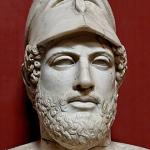
Pericles was born in Athens around 495 BCE into the aristocratic Alcmaeonid family. His father, Xanthippus, was a prominent military leader, and his mother, Agariste, was the niece of the reformer Cleisthenes. Pericles received an elite education, studying under philosophers like Anaxagoras, which influenced his rationalist and humanist outlook. He entered politics in the 460s BCE, aligning with the democratic faction led by Ephialtes. After Ephialtes' assassination in 461 BCE, Pericles became the dominant figure in Athenian politics, a position he held for over three decades until his death in 429 BCE.
Pericles' leadership was marked by his role as a strategos (general), a position he was elected to fifteen times. He promoted Athenian democracy, expanding citizen participation in government and introducing pay for public service to enable poorer citizens to hold office. His policies also included massive public works projects, such as the construction of the Parthenon and other buildings on the Acropolis, which employed thousands of Athenians and showcased Athens' cultural and political dominance.
Pericles' personal life was marked by tragedy. His two legitimate sons, Xanthippus and Paralus, died during the Plague of Athens in 430–429 BCE, which also claimed his sister and many other Athenians. Pericles himself succumbed to the plague in 429 BCE, leaving Athens without its most influential leader as the Peloponnesian War with Sparta raged on.
Historical Context
Pericles lived during the 5th century BCE, a period known as the Golden Age of Athens. This era followed the Greek victories over the Persian Empire in the Greco-Persian Wars (499–449 BCE), which left Athens as the leading city-state in the Greek world. The Delian League, an alliance of Greek city-states led by Athens, was transformed into an Athenian empire under Pericles' leadership, providing Athens with vast wealth and resources.
Athens under Pericles became the cultural and intellectual hub of the ancient world. The city attracted philosophers, artists, and playwrights, including Socrates, Sophocles, and Herodotus. Pericles' vision of Athens as a beacon of democracy, culture, and power set the stage for Western political thought and artistic achievement. However, Athens' dominance also provoked resentment among other Greek city-states, particularly Sparta, leading to the Peloponnesian War (431–404 BCE). Pericles' strategy during the war relied on Athens' naval superiority and the Long Walls connecting the city to its port, Piraeus. Though he died early in the conflict, his policies and leadership left an indelible mark on Athens and the broader Mediterranean world.
Beliefs
Pericles was a staunch advocate of democracy, believing in the power of the citizenry to govern itself. He famously articulated this vision in his Funeral Oration, recorded by Thucydides, where he praised Athens' democratic system, its openness to the world, and its commitment to the rule of law. Pericles also valued education, philosophy, and the arts, seeing them as essential to the flourishing of a free society. His association with philosophers like Anaxagoras and Protagoras reflected his belief in rational inquiry and humanism. However, his democratic ideals were not without limits; he supported the exclusion of women, slaves, and non-citizens from political participation, reflecting the social norms of his time.
Key Achievements
- Democratic Reforms: Pericles expanded Athenian democracy by introducing pay for public service, enabling poorer citizens to participate in government. He also strengthened the role of the Ecclesia (citizen assembly) and the courts, ensuring broader political engagement.
- Construction of the Acropolis: Pericles initiated the rebuilding of the Acropolis, including the Parthenon, the Propylaea, and the Temple of Athena Nike. These projects employed thousands of Athenians and showcased Athens' cultural and architectural brilliance.
- Leadership of the Delian League: Pericles transformed the Delian League, an alliance of Greek city-states, into an Athenian empire, securing Athens' dominance in the Aegean and funding its cultural and military ambitions.
- Funeral Oration: Pericles' Funeral Oration, delivered in 431 BCE, is one of the most famous speeches in history, celebrating Athens' democratic values, civic pride, and cultural achievements.
- Long Walls Construction: Pericles oversaw the construction of the Long Walls, which connected Athens to its port, Piraeus, ensuring the city's safety and supply lines during times of war.
- Promotion of Arts and Culture: Pericles' patronage of the arts and philosophy helped make Athens the cultural center of the ancient world, attracting thinkers like Socrates, Sophocles, and Herodotus.
- Military Leadership: As a strategos, Pericles led Athens through the early years of the Peloponnesian War, implementing a defensive strategy that preserved Athenian power despite initial setbacks.
- Citizenship Law: In 451 BCE, Pericles introduced a law restricting Athenian citizenship to those with two Athenian parents, reinforcing the exclusivity of Athenian democracy and identity.