Links
Life events
Wikipedia ↗
Wikipedia ↗
Wikipedia ↗
Wikipedia ↗
Wikipedia ↗
Wikipedia ↗
Wikipedia ↗
Wikipedia ↗
Wikipedia ↗
Article
Life Summary
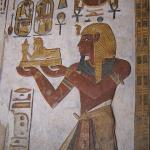
Ramesses III, born around 1217 BCE, was the second pharaoh of the Twentieth Dynasty of Egypt and is often regarded as the last great monarch of the New Kingdom. His reign, which lasted from approximately 1186 to 1155 BCE, was marked by both military triumphs and internal strife. Ramesses III ascended to the throne following the death of his father, Setnakhte, and immediately faced external threats from the so-called "Sea Peoples," a coalition of seafaring raiders. He successfully repelled their invasions in two major battles, as depicted in reliefs at his mortuary temple, Medinet Habu. Despite these victories, his reign was plagued by economic difficulties, labor strikes, and a harem conspiracy that ultimately led to his assassination. The conspiracy, orchestrated by one of his secondary wives, Tiye, aimed to place her son, Pentawer, on the throne. Though the plot was uncovered, Ramesses III did not survive the attempt on his life, dying in 1155 BCE.
Historical Context
Ramesses III ruled during a period of significant upheaval in the ancient world. The Late Bronze Age collapse was underway, leading to the decline of several major civilizations, including the Hittites and Mycenaeans. Egypt, though weakened, managed to survive this turbulent era under Ramesses III’s leadership. His reign is often seen as a last gasp of Egypt’s imperial power before a prolonged period of decline. The pharaoh’s efforts to defend Egypt’s borders and maintain its influence in the region were crucial in preserving the kingdom’s stability. His mortuary temple at Medinet Habu serves as a historical record of his military campaigns and the broader geopolitical challenges of the time. Ramesses III’s death marked the beginning of the end for the New Kingdom, as subsequent rulers struggled to maintain control over a fracturing empire.
Beliefs
Ramesses III, like his predecessors, adhered to the traditional religious beliefs of ancient Egypt. He presented himself as a divine ruler, the earthly embodiment of the god Amun, and undertook extensive building projects to honor the gods. His temple at Medinet Habu includes scenes of religious rituals and offerings, reflecting his devotion to the Egyptian pantheon. Ramesses III also emphasized the cult of the pharaoh, reinforcing the idea of the king as a living god and the intermediary between the people and the divine.
Key Achievements
- Military Victories: Successfully defended Egypt against invasions by the Sea Peoples in the Battle of Djahy (c. 1175 BCE) and the Battle of the Delta, preserving Egypt’s sovereignty.
- Construction Projects: Commissioned extensive building works, including his mortuary temple at Medinet Habu, which is one of the best-preserved temples of the New Kingdom.
- Economic and Administrative Reforms: Attempted to stabilize Egypt’s economy by redistributing land and resources, though these efforts were undermined by corruption and inefficiency.
- Cultural Patronage: Promoted Egyptian art and culture, leaving behind a rich legacy of inscriptions, reliefs, and monuments that provide insight into his reign.
- Defense of Egypt’s Borders: Strengthened Egypt’s defenses along its northern and western frontiers, ensuring the kingdom’s security during a period of widespread instability.
- Religious Leadership: Reinforced the role of the pharaoh as a religious figure, performing rituals and making offerings to the gods to maintain ma’at (cosmic order).
- Survival of the New Kingdom: Despite the challenges of his reign, Ramesses III’s leadership helped Egypt endure the Late Bronze Age collapse, delaying the kingdom’s eventual decline.