Links
Life events
380 BC
Death in Pataliputra
Samudragupta died in Pataliputra, leaving behind a legacy as one of the greatest rulers of the Gupta Empire. His military campaigns and political acumen significantly expanded the empire's territory.
Samudragupta died in Pataliputra, leaving behind a legacy as one of the greatest rulers of the Gupta Empire. His military campaigns and political acumen significantly expanded the empire's territory.
Wikipedia ↗
365 BC
Ashvamedha Sacrifice in Pataliputra
Samudragupta performed the Ashvamedha sacrifice in Pataliputra, a ritual to assert imperial sovereignty. This event symbolized his status as a paramount ruler of India.
Samudragupta performed the Ashvamedha sacrifice in Pataliputra, a ritual to assert imperial sovereignty. This event symbolized his status as a paramount ruler of India.
Wikipedia ↗
360 BC
Victory in Kosala
Samudragupta defeated the rulers of Kosala, an ancient kingdom in eastern India. This victory extended Gupta influence into the eastern regions of the subcontinent.
Samudragupta defeated the rulers of Kosala, an ancient kingdom in eastern India. This victory extended Gupta influence into the eastern regions of the subcontinent.
Wikipedia ↗
360 BC
Campaign in Bengal
Samudragupta led a successful campaign into Bengal, bringing the region under Gupta control. This further consolidated the empire's dominance in eastern India.
Samudragupta led a successful campaign into Bengal, bringing the region under Gupta control. This further consolidated the empire's dominance in eastern India.
Wikipedia ↗
355 BC
Conquest of Malwa
Samudragupta conquered Malwa, a strategically important region in central India. This victory allowed the Gupta Empire to control key trade routes and resources.
Samudragupta conquered Malwa, a strategically important region in central India. This victory allowed the Gupta Empire to control key trade routes and resources.
Wikipedia ↗
355 BC
Subjugation of Central Indian Tribes
Samudragupta campaigned against various tribes and kingdoms in central India, bringing them under Gupta suzerainty. This further expanded the empire's territorial control.
Samudragupta campaigned against various tribes and kingdoms in central India, bringing them under Gupta suzerainty. This further expanded the empire's territorial control.
Wikipedia ↗
350 BC
Southern Campaign in Kanchipuram
Samudragupta led a military campaign into southern India, reaching as far as Kanchipuram. His victories in the south demonstrated the reach and power of the Gupta Empire.
Samudragupta led a military campaign into southern India, reaching as far as Kanchipuram. His victories in the south demonstrated the reach and power of the Gupta Empire.
Wikipedia ↗
350 BC
Victory in Andhra Region
Samudragupta defeated the rulers of the Andhra region, further expanding the Gupta Empire's influence in southern India. This campaign solidified his reputation as a formidable conqueror.
Samudragupta defeated the rulers of the Andhra region, further expanding the Gupta Empire's influence in southern India. This campaign solidified his reputation as a formidable conqueror.
Wikipedia ↗
345 BC
Conquest of Delhi Region
Samudragupta extended his empire into the Delhi region, defeating local rulers and integrating the area into the Gupta Empire. This conquest strengthened his control over northern India.
Samudragupta extended his empire into the Delhi region, defeating local rulers and integrating the area into the Gupta Empire. This conquest strengthened his control over northern India.
Wikipedia ↗
340 BC
Battle in Ahichchhatra
Samudragupta fought a significant battle in Ahichchhatra, a major city in northern India, as part of his campaign to consolidate power in the Gangetic plain and beyond.
Samudragupta fought a significant battle in Ahichchhatra, a major city in northern India, as part of his campaign to consolidate power in the Gangetic plain and beyond.
Wikipedia ↗
335 BC
Birth in Pataliputra
Samudragupta was born in Pataliputra, the capital of the Gupta Empire, to Emperor Chandragupta I and Queen Kumaradevi. His birth marked the beginning of a lineage that would expand the Gupta Empire significantly.
Samudragupta was born in Pataliputra, the capital of the Gupta Empire, to Emperor Chandragupta I and Queen Kumaradevi. His birth marked the beginning of a lineage that would expand the Gupta Empire significantly.
Wikipedia ↗
335 BC
Coronation in Pataliputra
Samudragupta ascended to the throne after his father, Chandragupta I, and was coronated in Pataliputra. His reign is noted for military conquests and the expansion of the Gupta Empire.
Samudragupta ascended to the throne after his father, Chandragupta I, and was coronated in Pataliputra. His reign is noted for military conquests and the expansion of the Gupta Empire.
Wikipedia ↗
Article
Life Summary
Samudragupta (reigned c. 335–375 CE) was the second ruler of the Gupta Empire in ancient India, succeeding his father Chandragupta I. He is widely regarded as one of India’s greatest military conquerors, expanding the Gupta Empire through a series of campaigns across northern and southern India. His reign marked the beginning of the empire’s golden age, characterized by political stability, economic prosperity, and cultural flourishing. Samudragupta was also a patron of the arts, literature, and religion, particularly Hinduism and Buddhism. He is believed to have died around 375 CE, succeeded by his son Chandragupta II (Vikramaditya).
Historical Context
Samudragupta ruled during the 4th century CE, a period when the Gupta Empire emerged as a dominant power in India. His military campaigns consolidated control over much of the Indian subcontinent, laying the foundation for the empire’s golden age under his successors. The Gupta period is often called the "Classical Age" of India, marked by advancements in science, mathematics, astronomy, and the arts. Samudragupta’s reign was pivotal in establishing the Gupta Empire as a unifying force in a politically fragmented India, fostering trade, culture, and religious tolerance. His conquests and administrative policies set the stage for the empire’s later achievements.
Beliefs
Samudragupta was a devout Hindu but was known for his religious tolerance. He patronized both Hinduism and Buddhism, supporting scholars, poets, and religious institutions. His court was a center of learning, attracting intellectuals and artists. Despite his military prowess, he was also a poet and musician, reflecting the cultural synthesis of his era.
Key Achievements
- Expanded the Gupta Empire through military campaigns, conquering over 20 kingdoms in northern and southern India.
- Conducted the "Ashvamedha Yagna" (horse sacrifice), a ritual symbolizing imperial sovereignty.
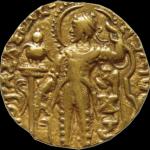
- Issued gold coins featuring his likeness, showcasing his military and cultural achievements.
- Patronized the arts and literature, fostering a golden age of Sanskrit poetry and drama.
- Established diplomatic relations with foreign powers, including the Kushan Empire and Ceylon (Sri Lanka).
- Promoted religious tolerance, supporting both Hindu and Buddhist institutions.
- Strengthened the administrative and economic foundations of the Gupta Empire, ensuring its prosperity.