Links
Life events
Wikipedia ↗
Wikipedia ↗
Wikipedia ↗
Wikipedia ↗
Wikipedia ↗
Wikipedia ↗
Wikipedia ↗
Article
Life Summary
Sennacherib (Akkadian: Sîn-ahhī-erība, meaning "Sîn has replaced the brothers") was the king of the Neo-Assyrian Empire from 705 BCE to 681 BCE. He was the son and successor of Sargon II, and his reign marked a period of both military expansion and architectural innovation. Sennacherib is best known for his campaigns against Babylon, the Levant, and Judah, as well as his ambitious building projects in Nineveh, which he transformed into a grand capital.
Born around 745 BCE, Sennacherib grew up during a time of Assyrian dominance in the Near East. He ascended to the throne in 705 BCE after the death of his father, Sargon II, who died in battle. Early in his reign, Sennacherib faced rebellions in Babylonia and the southern regions of his empire. His response was swift and brutal: in 689 BCE, he sacked Babylon, destroying its temples and diverting the Euphrates River over the city in an act of symbolic erasure. This event shocked the ancient world and cemented his reputation as a ruthless ruler.
Sennacherib also conducted campaigns in the Levant, most famously against the kingdom of Judah under King Hezekiah. The biblical account in the Book of Kings describes the Assyrian siege of Jerusalem in 701 BCE, during which Sennacherib’s forces were reportedly struck down by divine intervention—a narrative that has been debated by historians. Assyrian records, such as the Taylor Prism, claim a decisive victory, though Jerusalem itself was not captured.
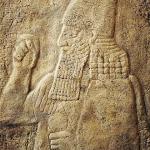
Domestically, Sennacherib focused on infrastructure and urban development. He expanded and beautified Nineveh, constructing massive walls, aqueducts, and the famous "Palace Without Rival," adorned with intricate reliefs depicting his military campaigns. His reign also saw advancements in engineering, including the construction of canals to supply water to Nineveh.
Sennacherib’s death in 681 BCE was violent and unexpected. According to the Babylonian Chronicle and later Greek historians like Herodotus, he was assassinated by one or more of his sons, possibly as part of a dynastic struggle. He was succeeded by his son Esarhaddon, who reversed some of his father’s policies, particularly regarding Babylon.
Historical Context
Sennacherib ruled during the height of the Neo-Assyrian Empire, a period marked by military conquest, administrative innovation, and cultural assimilation. The Assyrian Empire, centered in modern-day northern Iraq, was the dominant power in the Near East from the 10th to the 7th centuries BCE. Its success was built on a highly organized military, a sophisticated bureaucracy, and a policy of deporting conquered peoples to prevent rebellion—a practice Sennacherib continued.
The late 8th and early 7th centuries BCE were turbulent times in the ancient Near East. The Assyrian Empire faced constant challenges from subject states, including Babylonia, Elam, and the kingdoms of the Levant. Sennacherib’s reign was defined by his efforts to suppress these rebellions and maintain Assyrian dominance. His destruction of Babylon, however, was a controversial move that alienated many of his subjects and may have contributed to the empire’s eventual decline.
Sennacherib’s campaigns in Judah and his siege of Jerusalem are particularly significant in both Assyrian and biblical history. The biblical account of the siege, in which the Assyrian army is miraculously defeated, has been a subject of debate among historians. Assyrian records, such as the Taylor Prism, provide a different perspective, claiming that Hezekiah was forced to pay tribute. This discrepancy highlights the challenges of reconciling different historical sources.
Culturally, Sennacherib’s reign was a golden age for Assyrian art and architecture. His building projects in Nineveh showcased the empire’s wealth and power, while his palace reliefs provided detailed depictions of his military campaigns. These reliefs are invaluable to modern historians, offering insights into Assyrian warfare, technology, and propaganda.
Beliefs
Sennacherib, like other Assyrian kings, was a devotee of the Assyrian pantheon, with a particular reverence for the god Ashur, the chief deity of the Assyrian Empire. He presented himself as the earthly representative of Ashur, responsible for expanding the god’s domain through conquest. His inscriptions often attribute his victories to divine favor, reinforcing the idea that his rule was sanctioned by the gods.
Despite his devotion to Ashur, Sennacherib’s destruction of Babylon and its temples, particularly the Esagila (the temple of Marduk, Babylon’s patron god), was a radical departure from traditional Assyrian policy. Earlier Assyrian kings had sought to reconcile Babylonian and Assyrian religious traditions, but Sennacherib’s actions were seen as sacrilegious by many Babylonians. This may have contributed to the instability of his later reign and the eventual downfall of the Assyrian Empire.
Key Achievements
- Military Campaigns: Conducted numerous campaigns to suppress rebellions in Babylonia, the Levant, and Anatolia, securing Assyrian dominance in the region.
- Destruction of Babylon: In 689 BCE, Sennacherib sacked Babylon, destroying its temples and diverting the Euphrates River over the city, a symbolic act of erasure.
- Siege of Jerusalem: Led a campaign against the kingdom of Judah in 701 BCE, besieging Jerusalem and forcing King Hezekiah to pay tribute (though the city itself was not captured).
- Rebuilding of Nineveh: Transformed Nineveh into a grand capital, constructing massive walls, aqueducts, and the "Palace Without Rival," adorned with detailed reliefs.
- Engineering Projects: Oversaw the construction of canals and aqueducts to supply water to Nineveh, including the Jerwan Aqueduct, one of the earliest known aqueducts in history.
- Art and Propaganda: Commissioned detailed palace reliefs depicting his military campaigns, which serve as important historical and artistic records of the period.
- Administrative Reforms: Strengthened the Assyrian administrative system, improving the efficiency of tax collection and the management of conquered territories.
- Cultural Legacy: His reign is remembered for its architectural and artistic achievements, as well as its impact on the political landscape of the ancient Near East.