Links
Life events
Wikipedia ↗
Wikipedia ↗
Wikipedia ↗
Wikipedia ↗
Wikipedia ↗
Wikipedia ↗
Wikipedia ↗
Article
Life Summary
Skandagupta was a ruler of the Gupta Empire, which flourished in northern India from the early 4th to the late 6th century CE. He is believed to have been the son of Kumaragupta I, though some sources suggest he may have been a distant relative who ascended the throne after a succession crisis. His reign is traditionally dated from approximately 455 to 467 CE, though exact dates remain uncertain.
Skandagupta’s early life is poorly documented, but he is best known for his military campaigns. Shortly after ascending the throne, he faced a severe threat from the Huna (or Hephthalite) invasions, which had already weakened the Gupta Empire. Skandagupta successfully repelled these invasions, securing the empire’s northern frontiers. His victory is commemorated in inscriptions, such as the Bhitari pillar inscription, which praises his valor and leadership.
Despite his military successes, Skandagupta’s reign marked the beginning of the Gupta Empire’s decline. Economic strain, internal conflicts, and continued external pressures weakened the empire after his death. He likely died around 467 CE, though the exact circumstances of his death remain unknown.
Historical Context
Skandagupta ruled during the late classical period of Indian history, a time when the Gupta Empire was the dominant political and cultural force in northern India. The empire, often referred to as the "Golden Age of India," was renowned for its advancements in science, mathematics, astronomy, literature, and art. However, by Skandagupta’s time, the empire faced significant challenges, including invasions by the Huna tribes from Central Asia.
The Huna invasions posed a grave threat to the stability of the Gupta Empire. These nomadic warriors had already overrun parts of Central Asia and Persia, and their incursions into India disrupted trade, agriculture, and governance. Skandagupta’s successful defense against the Hunas was crucial in preserving the Gupta Empire’s territorial integrity, at least temporarily. His reign is often seen as a last period of resurgence before the empire’s gradual fragmentation.
Skandagupta’s leadership is also notable for its role in maintaining the cultural and administrative legacy of the Guptas. The empire’s centralized bureaucracy, patronage of the arts, and promotion of Hinduism and Buddhism continued under his rule, though the economic strain of warfare likely accelerated the empire’s decline after his death.
Beliefs
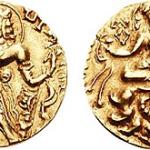
Skandagupta, like many Gupta rulers, was a patron of Hinduism, particularly the worship of Vishnu. His inscriptions and coins often feature Hindu iconography, such as the Garuda (the mount of Vishnu) and references to his divine right to rule. However, the Gupta Empire was also known for its religious tolerance, and Buddhism and Jainism continued to thrive during his reign. Skandagupta’s personal beliefs are not extensively documented, but his policies reflected the Gupta tradition of supporting multiple religious traditions.
Key Achievements
- Defeated the Huna Invasions: Successfully repelled the Huna (Hephthalite) attacks, securing the Gupta Empire’s northern frontiers and preventing further incursions during his reign.
- Restored Imperial Authority: Briefly revitalized the Gupta Empire after a period of decline, reasserting control over key regions and maintaining administrative stability.
- Commemorative Inscriptions: Left behind inscriptions, such as the Bhitari pillar inscription, which provide valuable historical records of his reign and military victories.
- Economic and Cultural Patronage: Continued the Gupta tradition of supporting scholars, artists, and architects, contributing to the empire’s cultural legacy.
- Coinage Reforms: Issued gold coins featuring his likeness and Hindu symbols, reinforcing the empire’s economic stability and cultural identity.
- Military Leadership: Demonstrated exceptional military strategy and leadership, earning a reputation as a defender of the empire against external threats.