Links
Life events
Wikipedia ↗
Wikipedia ↗
Wikipedia ↗
Wikipedia ↗
Wikipedia ↗
Wikipedia ↗
Wikipedia ↗
Article
Life Summary
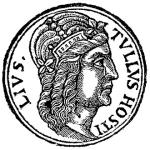
Tullus Hostilius was the third legendary king of Rome, reigning from 673 BCE to 642 BCE, according to traditional Roman historiography. He succeeded Numa Pompilius and was known for his warrior-like nature, contrasting sharply with his predecessor’s peaceful rule. Born into a prominent Roman family, Tullus was raised in an era where Rome was still consolidating its power in central Italy. His reign was marked by military campaigns, most notably the destruction of Alba Longa, Rome’s mother city, after a conflict resolved by the legendary duel of the Horatii and Curiatii. Tullus also strengthened Rome’s military institutions, including the expansion of the Roman army and the construction of the Curia Hostilia, the first permanent meeting place for the Roman Senate. His death is shrouded in myth: he was said to have been struck down by a bolt of lightning as divine punishment for neglecting religious duties, a fate that underscored the Roman belief in the importance of piety.
Historical Context
Tullus Hostilius ruled during a formative period in Rome’s early history, a time when the city was transitioning from a small settlement into a regional power. This era was characterized by frequent conflicts with neighboring tribes and city-states, such as the Sabines, Latins, and Etruscans. Rome’s expansion under Tullus set the stage for its future dominance in Italy and beyond. His reign also reflected the broader cultural and political dynamics of the Italian Peninsula, where city-states vied for supremacy through military prowess and strategic alliances. Tullus’s destruction of Alba Longa, a city with deep mythological ties to Rome’s founding, symbolized Rome’s growing independence and ambition. His military reforms and institutional developments laid the groundwork for Rome’s republican system, which would emerge a few centuries later. Tullus’s legacy is a blend of historical fact and legend, illustrating how early Roman leaders were often mythologized to embody the values and aspirations of the state.
Beliefs
Tullus Hostilius is often depicted as a ruler who prioritized military strength and expansion over religious observance, a trait that ultimately led to his downfall in Roman tradition. Unlike his predecessor Numa Pompilius, who was revered for his piety, Tullus was seen as a king who neglected the gods, leading to his divine punishment. This narrative served as a moral lesson for Romans, emphasizing the importance of balancing military ambition with religious duty. His reign also reflected the Roman belief in the concept of pietas—duty to the gods, country, and family—which became a cornerstone of Roman identity.
Key Achievements
- Destruction of Alba Longa: Tullus waged war against Alba Longa, Rome’s mother city, and destroyed it after the conflict was decided by the duel of the Horatii and Curiatii. This victory solidified Rome’s dominance in the region.
- Military Reforms: Expanded and reorganized the Roman army, increasing its effectiveness and laying the foundation for Rome’s future military successes.
- Construction of the Curia Hostilia: Built the first permanent meeting place for the Roman Senate, strengthening the city’s political institutions.
- Expansion of Roman Territory: Through military campaigns, Tullus extended Rome’s influence over neighboring tribes and city-states, including the Sabines and Latins.
- Establishment of the Fetial Laws: Instituted religious and legal procedures for declaring war, ensuring that Rome’s military actions were conducted with divine approval.
- Integration of Alba Longa’s Population: Absorbed the surviving population of Alba Longa into Rome, increasing the city’s manpower and resources.
- Promotion of Roman Identity: His reign reinforced the idea of Rome as a distinct and powerful entity, separate from its mythological origins in Alba Longa.