Links
Life events
Wikipedia ↗
Wikipedia ↗
Wikipedia ↗
Wikipedia ↗
Wikipedia ↗
Wikipedia ↗
Wikipedia ↗
Wikipedia ↗
Wikipedia ↗
Wikipedia ↗
Wikipedia ↗
Article
Life Summary
Tutankhamun, originally named Tutankhaten, was born around 1341 BCE, the son of Pharaoh Akhenaten (formerly Amenhotep IV) and likely one of his sisters. His early life unfolded during the controversial Amarna Period, when Akhenaten imposed the worship of the Aten, a single solar deity, and moved Egypt’s capital to Akhetaten (modern Amarna). Tutankhamun ascended the throne at approximately age nine, following the brief reign of Neferneferuaten, possibly his half-sister or stepmother. His reign, from roughly 1332 to 1323 BCE, marked a return to traditional Egyptian religion and the restoration of the god Amun’s supremacy, reflected in his name change from Tutankhaten (“Living Image of Aten”) to Tutankhamun (“Living Image of Amun”).
During his reign, Tutankhamun worked to repair the damage caused by Akhenaten’s religious revolution, reopening temples, reinstating the priesthood, and restoring Thebes as the religious center of Egypt. He married his half-sister Ankhesenamun, with whom he had two stillborn daughters, as evidenced by the mummified fetuses found in his tomb. Tutankhamun’s rule was largely overshadowed by his powerful advisors, including Ay (his successor) and Horemheb, the general who would later become pharaoh. Tutankhamun died unexpectedly around the age of 19, likely from complications related to a leg fracture and malaria, though theories of foul play persist despite limited evidence.
Historical Context
Tutankhamun’s reign occurred during the late 18th Dynasty of the New Kingdom, a period of Egypt’s greatest power and cultural flourishing. His father, Akhenaten, had upended centuries of religious tradition by promoting Atenism, a monotheistic or henotheistic worship of the sun disk, Aten. This religious shift destabilized Egypt’s political and social structures, alienating the powerful priesthood of Amun and weakening Egypt’s international standing. Tutankhamun’s reign was a critical turning point, as it sought to reconcile Egypt with its past and restore stability. However, his early death left the task of full restoration to his successors, particularly Horemheb, who systematically erased the Amarna Period from official records.
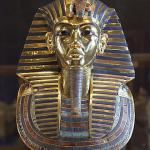
Tutankhamun’s significance in history is largely due to the discovery of his nearly intact tomb (KV62) in the Valley of the Kings by Howard Carter in 1922. Unlike the tombs of other pharaohs, which were looted in antiquity, Tutankhamun’s tomb provided an unprecedented glimpse into the material culture, art, and burial practices of New Kingdom Egypt. The treasures found within, including the iconic golden death mask, have captivated the public imagination and made Tutankhamun one of the most famous pharaohs, despite his relatively minor historical impact.
Beliefs
Tutankhamun’s reign was defined by his adherence to traditional Egyptian polytheism, particularly the worship of Amun, the king of the gods. His restoration of Amun’s cult was not merely a religious act but a political one, aimed at reuniting Egypt and reasserting the pharaoh’s role as the intermediary between the gods and the people. The “Restoration Stela,” erected during his reign, details his efforts to rebuild temples, provide offerings, and reinstate the priesthood, emphasizing his piety and devotion to the old gods. Despite his youth, Tutankhamun’s actions reflected a deep commitment to the religious and cultural traditions that had defined Egypt for millennia.
Key Achievements
- Restoration of Traditional Religion: Reversed Akhenaten’s Atenist reforms, reinstating the worship of Amun and other traditional deities, and restoring Thebes as Egypt’s religious capital.
- Rebuilding of Temples: Initiated extensive construction and restoration projects at temples across Egypt, including Karnak and Luxor, to repair the damage caused by the Amarna Period.
- Diplomatic Relations: Maintained Egypt’s diplomatic ties with foreign powers, as evidenced by gifts and correspondence found in the Amarna letters, though his reign saw a decline in Egypt’s international influence.
- Military Campaigns: Though young, Tutankhamun is depicted in inscriptions leading military campaigns, likely symbolic rather than actual, to reassert Egypt’s control over Nubia and Syria-Palestine.
- Burial and Tomb: His tomb, KV62, is the most intact royal tomb ever discovered in the Valley of the Kings, containing over 5,000 artifacts that provide invaluable insights into New Kingdom burial practices and material culture.
- Cultural Legacy: His death mask and other artifacts have become global symbols of ancient Egypt, shaping modern perceptions of Egyptian art and history.
- Succession: His death marked the end of the Thutmosid line, leading to the rise of Ay and later Horemheb, who continued the restoration of Egypt’s traditional order.